CEICData.com © 2018 Copyright All Rights Reserved
.png?width=160&name=ceic-logo-Vector%20logo%20no%20tagline%20(002).png)

The US economy has defied predictions that it would be in a recession by now, mostly shrugging off the effects of a historic rate-hiking cycle. (To be sure, the weak payrolls number at the start of August jolted markets, disturbing the narrative that the Federal Reserve was guiding the US to a soft landing.)
Economic resilience isn't uniform across the US, and it's especially important to examine the fortunes of key "swing states" in the upcoming Presidential election. Using the State Coincident Indexes, which are calculated by the Philadelphia Fed and depend largely on labor-market indicators, we can see that 8 of the 50 states saw their economies contract in the second quarter.

A "technical recession" is defined as two consecutive quarterly declines in real GDP. As a proxy for this, we can examine the six-month change in the State Coincident Indexes. As our first chart shows, this suggests that Maryland, Kansas, Rhode Island and Ohio (the most "purple" state in this group, though it has trended Republican in recent elections) could be in recession.
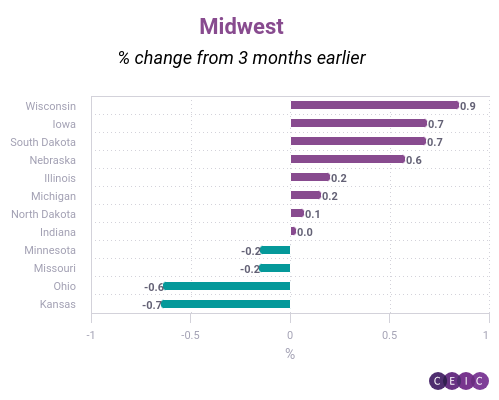
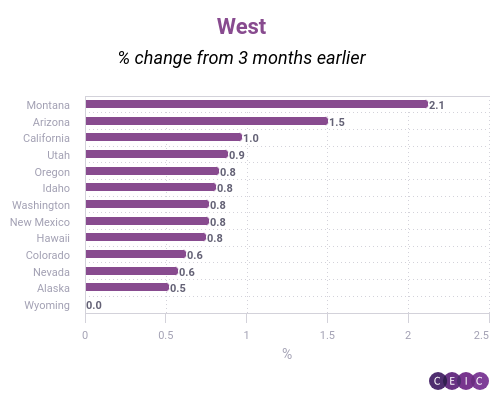
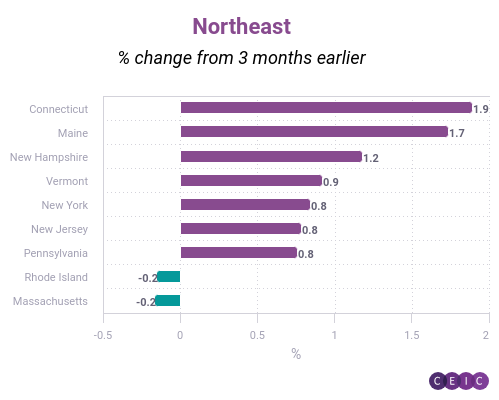
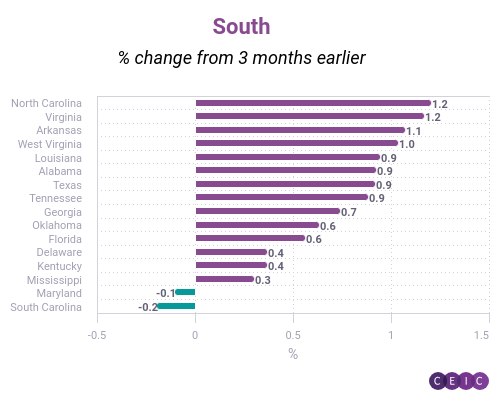
The US State Coincident Indexes combine four state-level indicators – nonfarm payroll employment, average hours worked in manufacturing by production workers, the unemployment rate, and the sum of wages and salaries with business owners' income.
In the three months to June 2024, the largest drop was registered in Kansas (-0.7% in June compared to March). Along with Ohio, Missouri and Minnesota, this means half of the states posting negative economic growth recently are in the Midwest.
Rhode Island, Massachusetts, Maryland and South Carolina all posted contractions of 0.2% or less.
The West is posting the most uniform growth, except for Wyoming, which flatlined; Montana led the nation, posting an increase of 2.1%.
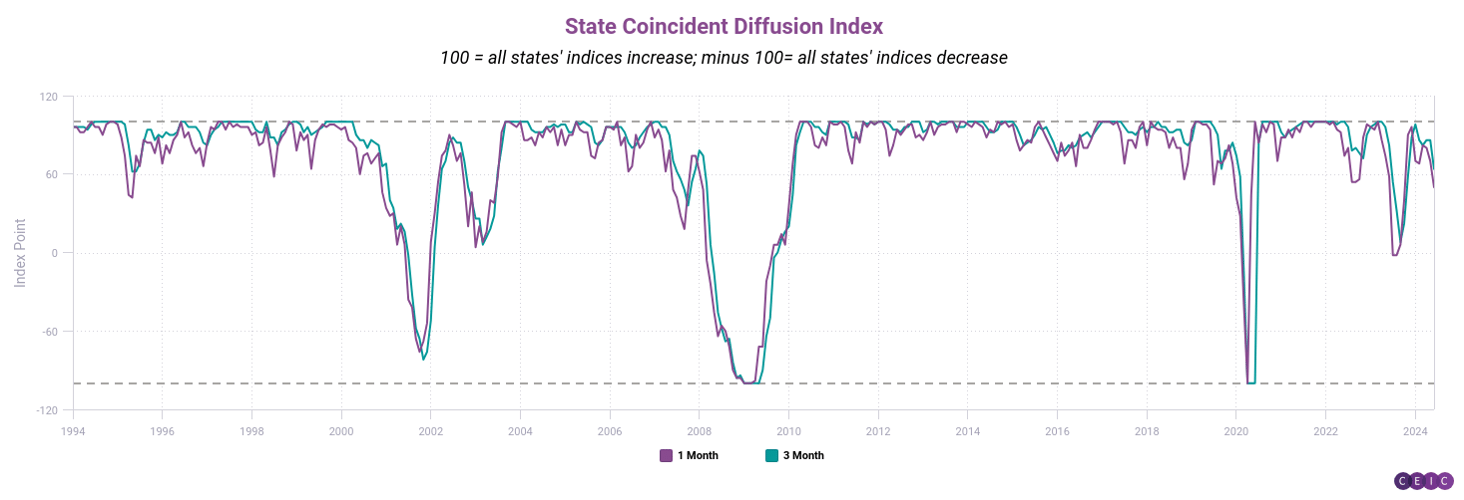
Finally, we chart the diffusion indices over the past three decades. The pandemic and global financial crisis recessions stand out: 100% of the states were in contraction. This was not the case in the recession of the early 2000s, when some states never stopped growing.
While 41 of 50 states posting growth in June 2024 would seem positive, this marks a deterioration over the previous month and quarter.
If you are a CEIC user, access the story here.
If you are not a CEIC client, explore how we can assist you in generating alpha by registering for a trial of our product: https://hubs.la/Q02f5lQh0