CEICData.com © 2018 Copyright All Rights Reserved
.png?width=160&name=ceic-logo-Vector%20logo%20no%20tagline%20(002).png)

Hanging your hat on now versus then
Making decisions about the future based on forecasts has always been a key element of the investment process. Historically, those forecasts rested on qualitative analysis of the best available current information. But, with the exponential growth of computing power, and the concurrent development of machine learning to harness that power, the reliability of data-driven forecasts – at least in the short run – has grown by leaps and bounds. That, in turn, opens the door to quantitative analysis and modeling.
The current decade has seen a dramatic increase in the number and scope of what are known as “nowcasts” which utilize currently available data points to estimate classic macroeconomic datapoints, such as GDP growth and the rate of inflation, ahead of their official release.
If and when these nowcasts correlate strongly with the lagged official data, they offer a timely alternative to those official datapoints for systematic macro use cases. But the question of their reliability, and their ability to underpin credible quantitative strategies, remains open.
It is a question we will explore in this Quants Corner, utilizing some of the nowcasts developed by CEIC which is part of ISI Global Markets’ Data & Analytics division. Using CEIC’s Inflation and GDP Nowcast series, we construct and evaluate macro-level factors as quantitative investment signals across multiple asset classes, including equity country indices, currencies, and investment-grade bonds.
Choosing and mixing the ingredients
We use two of CEIC’s multiple nowcast series to conduct this experiment. They are the Headline Inflation Nowcast and the GDP Nowcast (Current Quarter). Both series provide data for multiple countries, are expressed as a year-over-year (YoY) and are available at a minimum weekly frequency.
From these series, we construct macroeconomic country and currency level factors. The first set of factors consists of the raw, untransformed nowcast values. For each macroeconomic indicator, we compile all aggregate country or currency-level time series into single data frame.
Because raw YoY GDP growth is not always directly comparable across a mixed universe of Emerging and Developed Markets countries due to structural growth differences, we additionally construct two normalized GDP-based factors. The construction of each factor is outlined below:
1. InflationNowcast: raw, untransformed series, latest available values per date.
2. GDPNowcast: raw, untransformed series, latest available values per date.
3. GDPNowcastCh3mo: calculate the difference between the latest estimated GDP Nowcast growth figures and the estimate from 3 months prior.
a. x – lag(x, 3m)
4. GDPNowcastSurprise: calculate the difference between the latest estimated GDP Nowcast growth figures and actual GDP growth (semi-annual).
a. GDP Growth – GDP Nowcast
Each CEIC Nowcast factor is evaluated as a macro-level signal across equity country indices, currencies, and investment-grade bonds. For each asset class, we run separate long/short quintile-based backtests for all four of the factors constructed from CEIC’s Inflation and GDP Nowcast series. Each signal is tested over the maximum available history, which spans at least five years. We additionally evaluate performance across multiple holding periods, including weekly, monthly, and semi-annual rebalancing frequencies.
At each rebalance, assets are ranked by their latest available factor values and sorted into quintiles. Portfolio returns are then constructed by going long the top quintile and short the bottom quintile.
Scoring the factors
To measure performance, we utilized MSCI Total Return Indices for equity country returns, Spot FX rates (XDR terms) for currencies and Cbonds Investment Grade Total Return Indices for bond markets. Results for the four factors, which are summarized in the tables below, are reported throughout 2025.
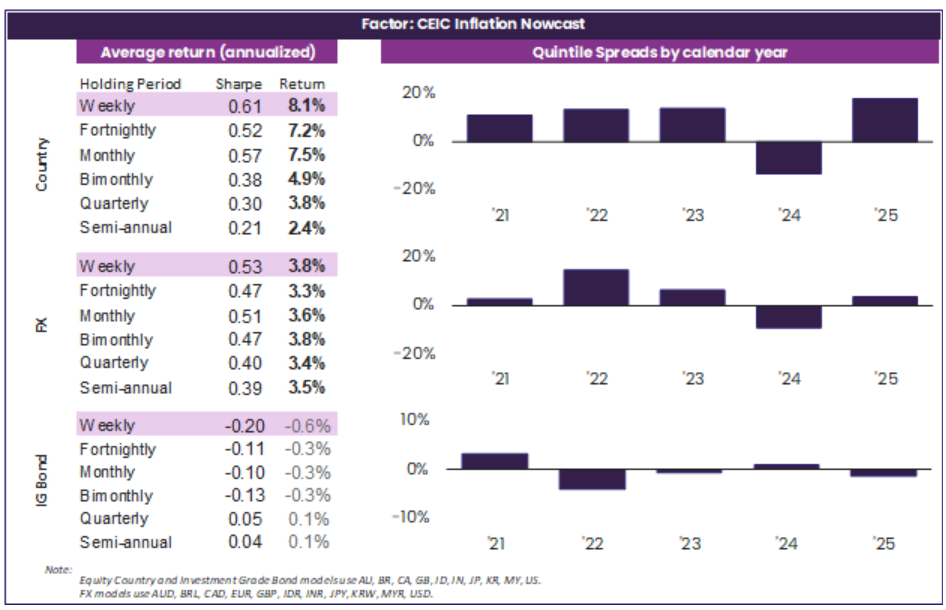
1. CEIC Inflation Nowcast
The Raw Inflation Nowcast factor exhibits the strongest and most consistent performance across both equity country and foreign exchange rotation strategies.
2. CEIC GDP Nowcast
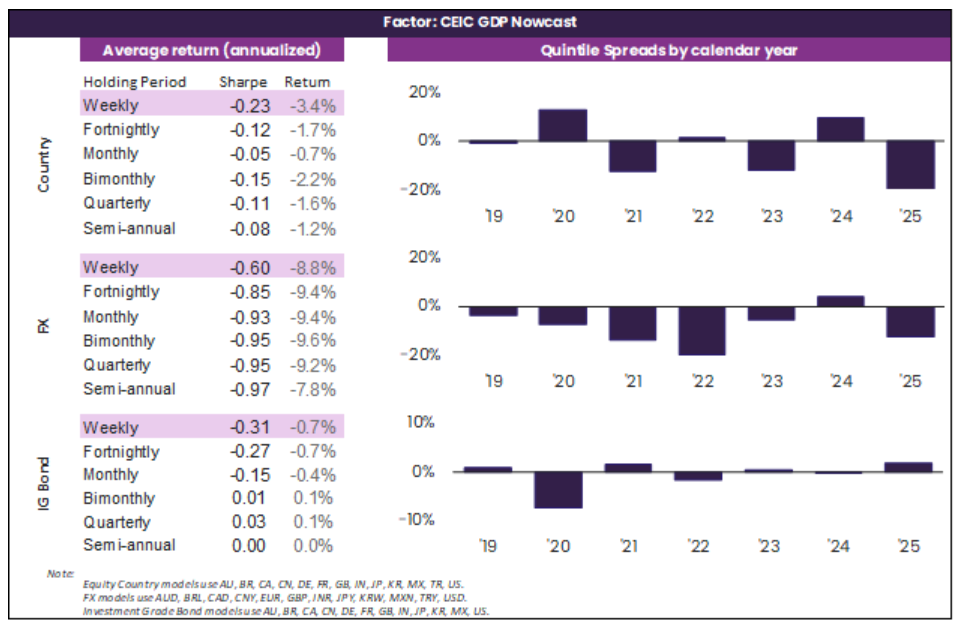
The Raw GDP Nowcast demonstrates particularly strong performance in FX markets as a reversal indicator and remains robust across multiple trading horizons. However, because this signal is not normalized, it may be more susceptible to noise and structural biases across countries.
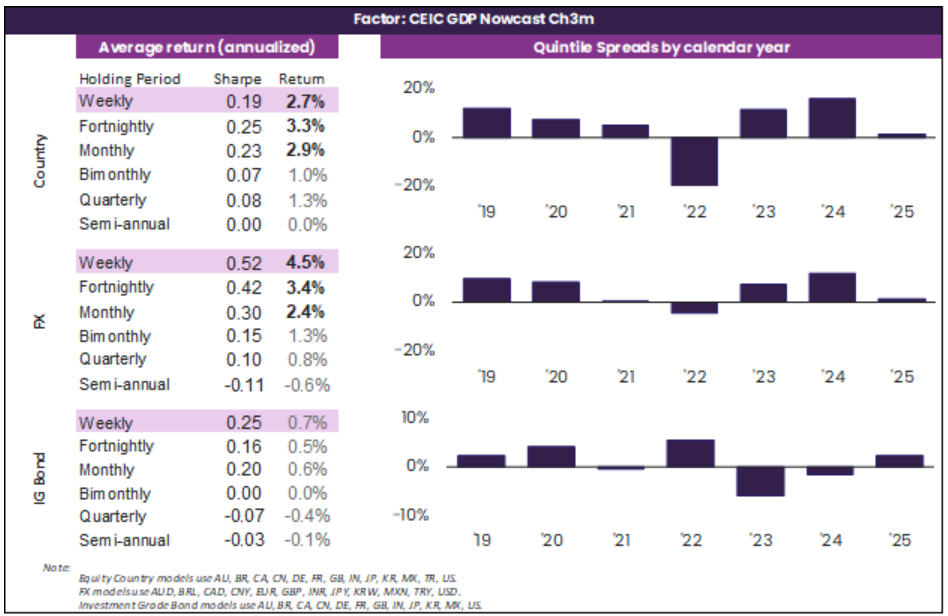
The GDP Nowcast three month change factor yields the most consistent performance as a positive momentum signal across all three universes tested.
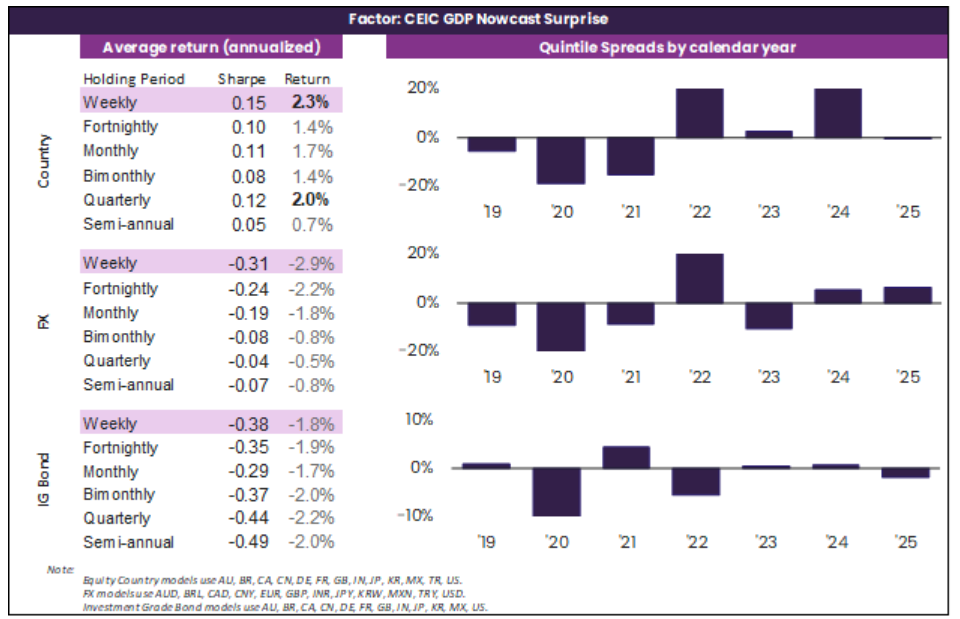
The GDP Nowcast Surprise factor delivers the strongest performance across investment-grade bond markets as a reversal signal, consistent with bond pricing being highly sensitive to shifts in growth expectations.
Current Nowcast: Enough to build on
Across asset classes, the results indicate that CEIC Nowcasts can provide strong predictive signals, but those signals depend on the factors that are applied.
This initial analysis suggests that it is worthwhile to look at other nowcast series such as CEIC’s balance of payments nowcasts and developing factors to unlock the signals. That will be the subject of future Quants Corners.
About CEIC
Founded in 1992, CEIC curates the highest quality and most timely economic data from traditional and high frequency alternative sources, enabling economists and investment professionals to understand the development and near-real time performance of the markets they cover. Data is available for over 200 countries and territories, with a specific focus on emerging markets through deep, country-specific databases.
ceicdata.com
About EPFR
CEIC’s sister company EPFR has been publishing monthly Quants Corners since 2018, with topics in 2025 spanning sector modelling using EPFR’s Stock Flows database, single-stock leverage fund behavior, and a principal components analysis of cryptocurrencies, among others. Explore these further on epfr.com/insights.
EPFR is the industry leader in providing fund flows and asset allocation data to financial institutions worldwide, delivering an unparalleled picture of institutional and retail investor flows and fund manager allocations driving global markets. Tracking over 156,000 traditional and alternative fund-share classes domiciled around the world with $71 trillion in total assets and covering 93 percent of global equity fund products as measured by assets under management, EPFR’s clients include the world’s biggest banks and money managers.
epfr.com
If you are not a CEIC client, explore how we can assist you in generating alpha by registering for a trial of our product: https://hubs.la/Q02f5lQh0