CEICData.com © 2018 Copyright All Rights Reserved
.png?width=160&name=ceic-logo-Vector%20logo%20no%20tagline%20(002).png)

Recent developments in China-Japan trade relations have drawn attention. Rare-earth elements, magnets, chemicals and technology-related components could be affected.
Rare earths have particular importance to key Japanese manufacturing sectors. We've tapped granular trade data from UNComtrade to illustrate Japan’s reliance on imports in a globalized sector where China plays a dominant role.
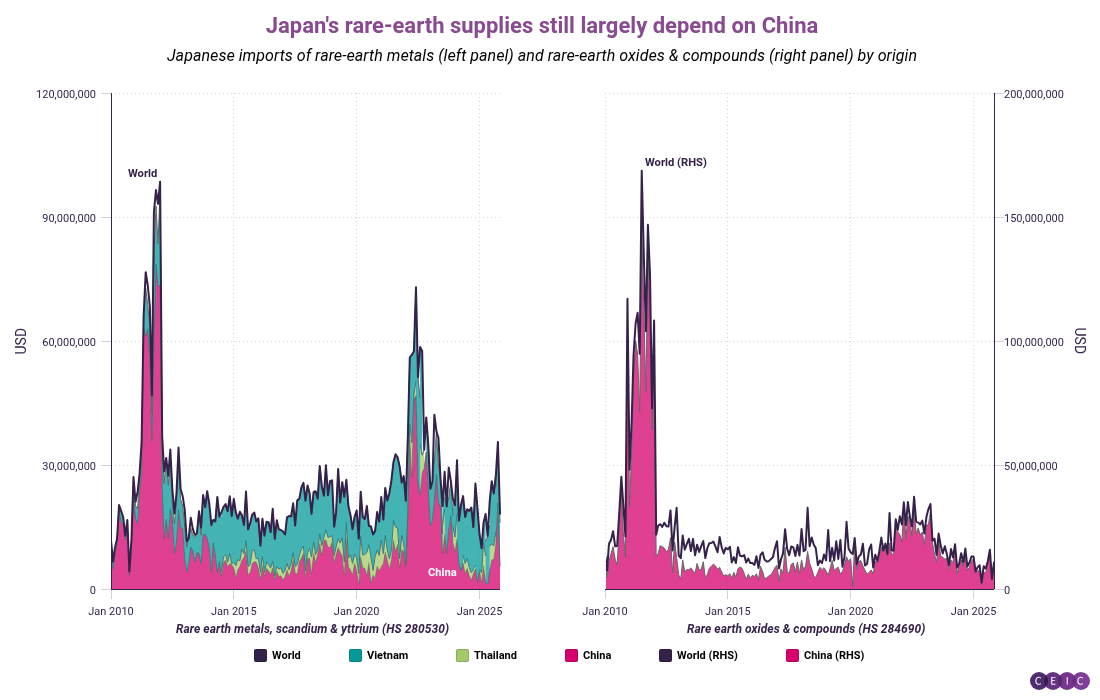
Although Japan has sought to diversify its sourcing of critical minerals by partnering with countries such as Vietnam, it remains dependent on China for roughly 60% of such products. This dependence is higher for heavy rare earths, which are essential for EVs, electronics and advanced defense systems, as well as for rare-earth oxides and compounds that are both processed into high-purity metals and alloys and are used directly in catalysts, batteries, and semiconductor-related applications.
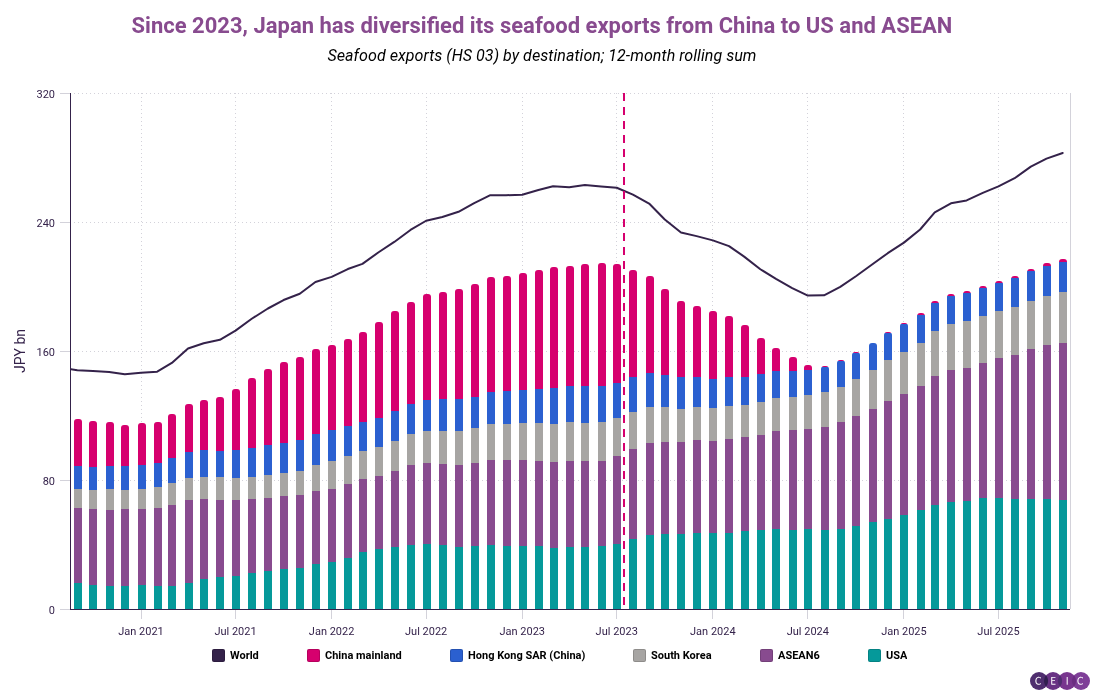
We've also charted how the nations' trade relationship has shifted in several other sectors. For instance, Japan's seafood exports have shifted to ASEAN economies and the US.
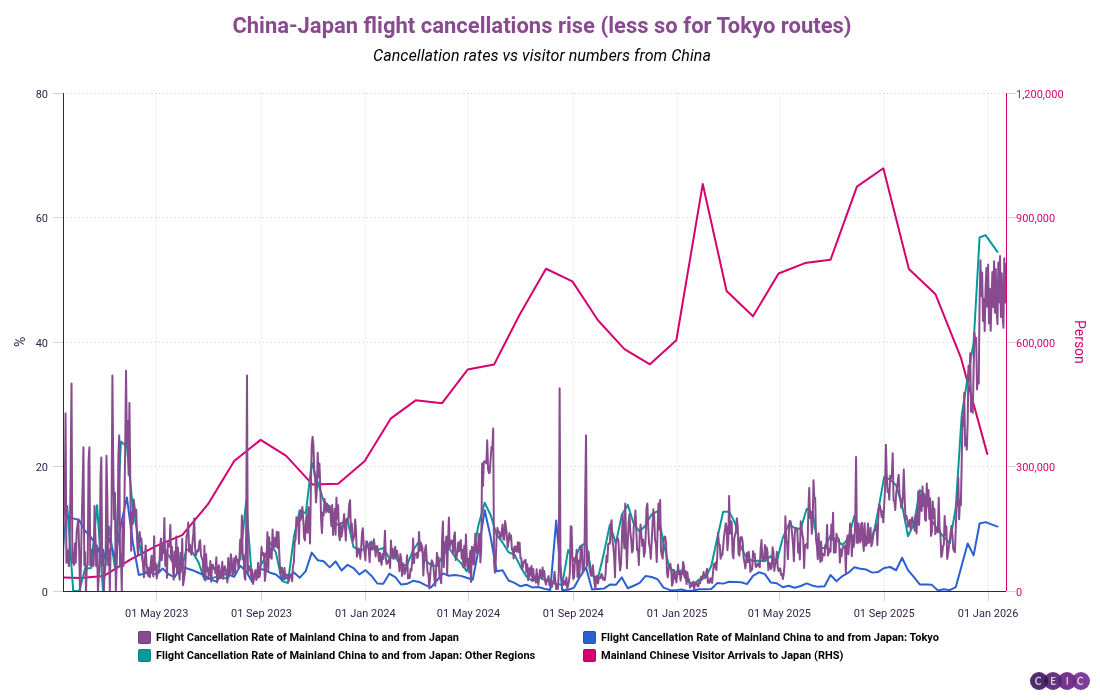
In tourism, China-Japan flights have seen a rise in cancellations. High-frequency air traffic data from VariFlight (which leads official Japanese visitor statistics by more than a month) shows that this has especially been the case for more tourist-dependent routes, such as Kyoto; this is less the case for more business-oriented Tokyo routes. Mainland Chinese visitor numbers for November increased 3% from the same period in 2024, compared to the 40.7% surge in the first ten months of 2025.
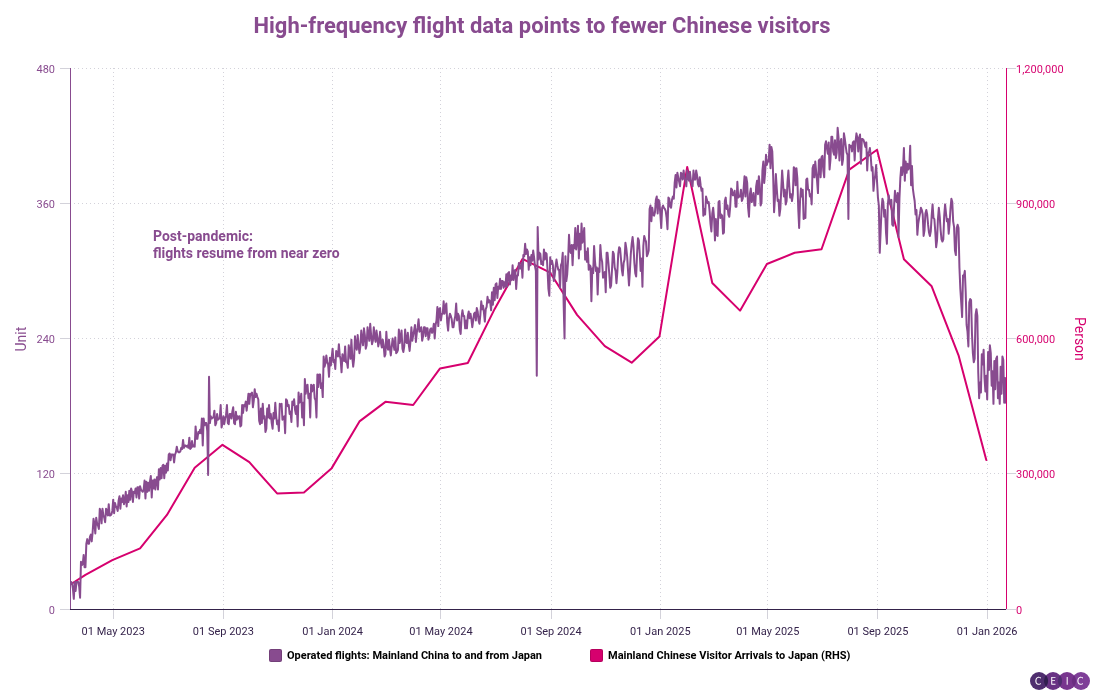
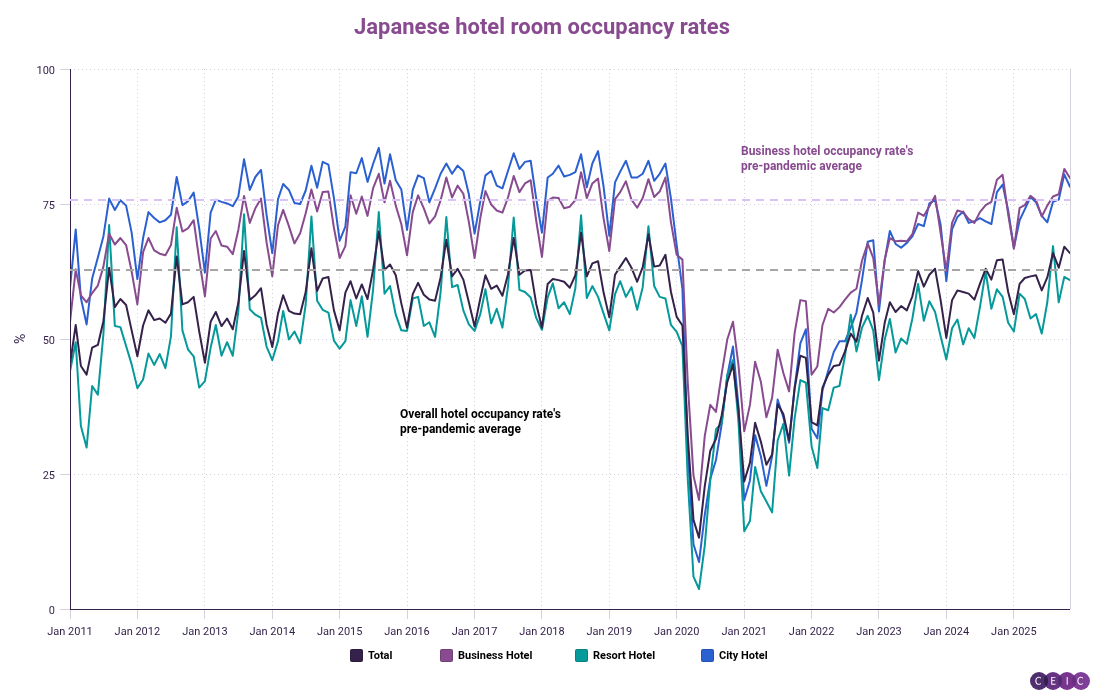
Overall visitor arrivals and hotel room occupancy had not fallen much as of November 2025. JTB, Japan's largest travel agency, predicts that the number of foreign tourists will drop slightly in 2026, while the weaker yen means the nation will still be an attractive destination -- despite a tripling of a tourist tax in July to JPY 3,000 to tackle over-tourism.

If you are a CEIC user, access the story here.
If you are not a CEIC client, explore how we can assist you in generating alpha by registering for a trial of our product: https://hubs.la/Q02f5lQh0