CEICData.com © 2018 Copyright All Rights Reserved
.png?width=160&name=ceic-logo-Vector%20logo%20no%20tagline%20(002).png)

The Indian equity market has distinguished itself as one of the world's top performers, attracting increasing levels of foreign investment. This influx is also playing a pivotal role in supporting the nation's currency.
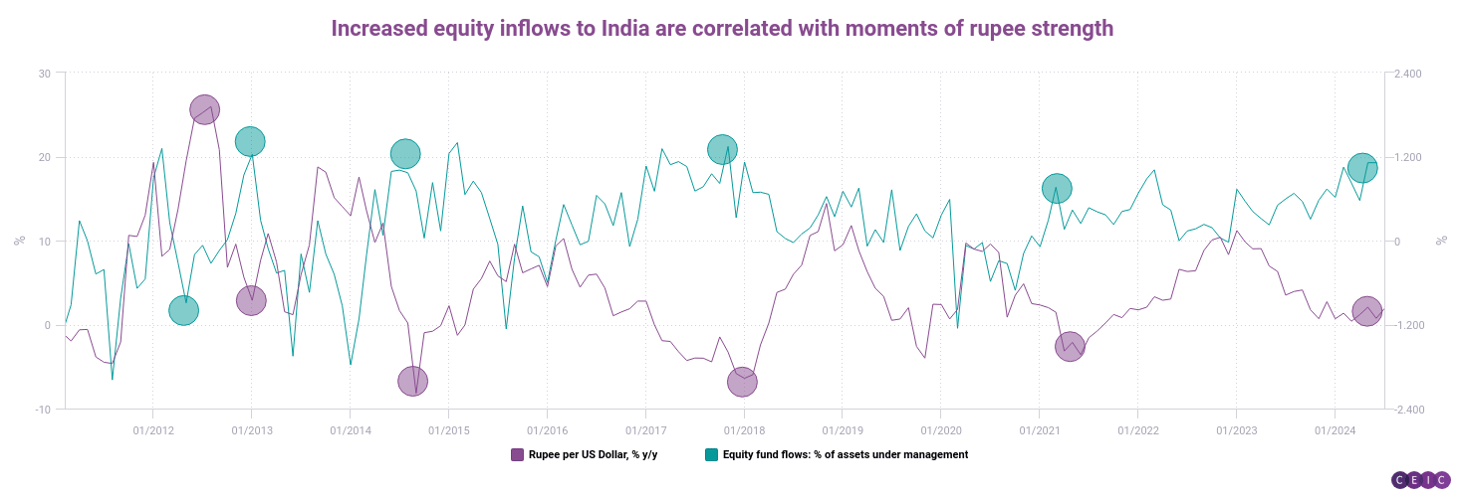
Using data from our partners at EPFR, we can see that net fund flows into Indian equities are having a significant influence on the rupee (INR). As our chart shows, several of the rupee's strongest recent performances against the dollar coincide with substantial net inflows into Indian equities. (Both are measured in percentage change, year-on-year.)
India's central bankers watch the exchange rate closely and are known for intervening in the market to manage the currency. Our second chart features CEIC's newly integrated timeseries data from the Reserve Bank of India (RBI), revealing trends in how this institution accumulates (and sometimes sells) foreign reserves.
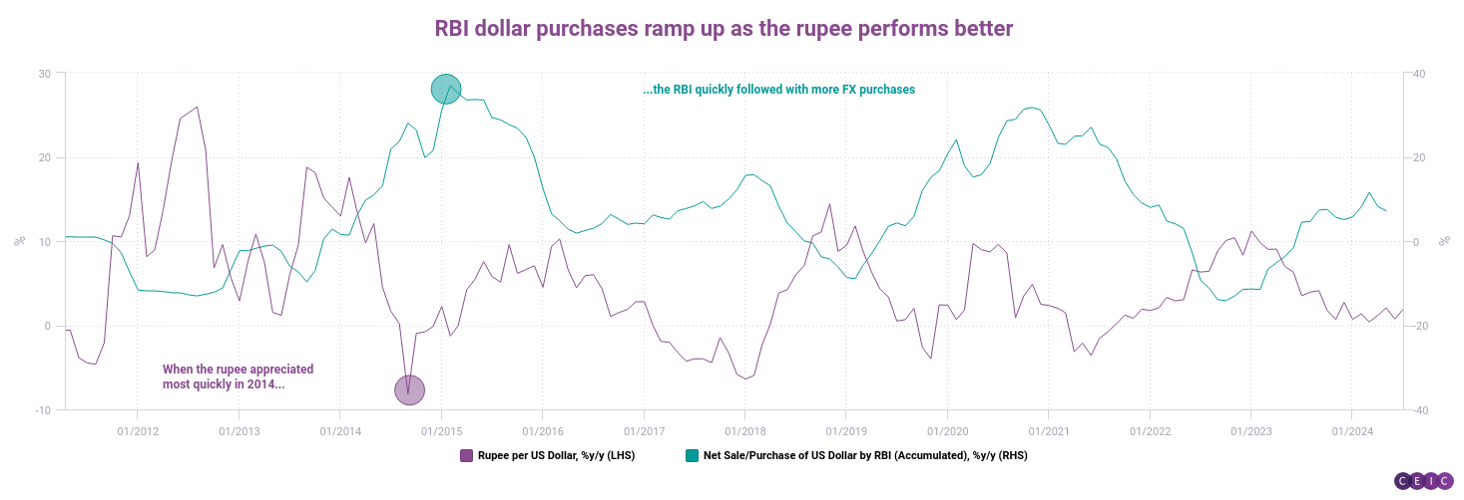
Over the long term, the rupee has steadily depreciated against the dollar. But the RBI intensifies its accumulation of foreign reserves during periods when the rupee strengthens or when its depreciation slows. (September 2014, January 2018 and the bulk of 2021 stand out.)
The RBI has also sold reserves when the rupee weakened, notably in 2019 and 2022.
The EPFR datasets available on CEIC cover more than 151,000 traditional and alternative fund share classes accounting for more than $52 trillion in total assets – delivering a complete picture of the institutional and retail investor flows and fund manager allocations that drive global markets.
If you are a CEIC user, access the story here.
If you are not a CEIC client, explore how we can assist you in generating alpha by registering for a trial of our product: https://hubs.la/Q02f5lQh0