CEICData.com © 2018 Copyright All Rights Reserved
.png?width=160&name=ceic-logo-Vector%20logo%20no%20tagline%20(002).png)

Producers of global agricultural commodities face a complex environment every year. Weather conditions, demand, and prices for inputs like diesel and fertilizer are all volatile.
We can gain greater insight into conditions for farmers in Brazil, the world's largest soybean producer, by considering another key expense tracked by a dataset recently added to CEIC: freight prices, as compiled by the National Supply Company (CONAB).
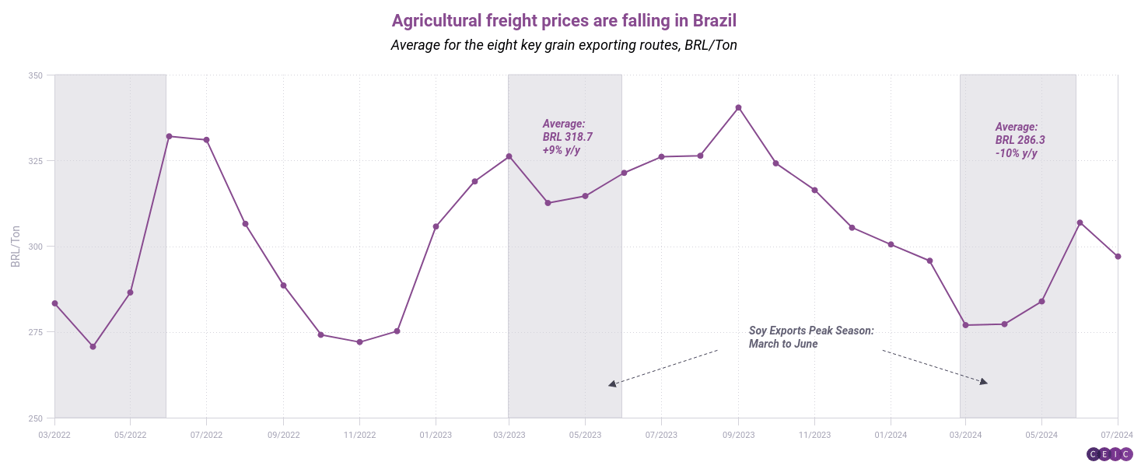
Our chart tracks the average freight price for eight key export routes. (They reflect grain shipping -- mostly corn -- rather than export routes for soybeans specifically, but will closely reflect what soybean farmers would need to pay.)
We've highlighted the March to June period -- the peak season for soy exports. In 2022 and 2023, freight prices saw a run-up around the time of this peak demand.
In 2024, however, the usual seasonal pattern did not occur. Instead, the average cost to ship from agricultural areas to port dropped 10% year on year -- even as the price of the diesel used to fuel trucks and trains rose 7% during the same period.
What happened? The atmospheric effect known as El Niño is a factor. It prompted heavy rainfall and flooding in Brazil's south, and is currently exacerbating drought and wildfires in the center of the country. The result was a lower crop yield -- and, hence, less demand for freight.
The total volume of Brazil's soy exports from March to June fell 4% year-on-year to 54.7 million tons. As wildfires continue to burn, agricultural production is still at risk for the rest of the year -- with a potential continuing knock-on effect for freight demand and prices. Brazil's statistics office estimated in August that this year's harvest of cereals, legumes, and oilseeds will be 6% lower year-on-year.
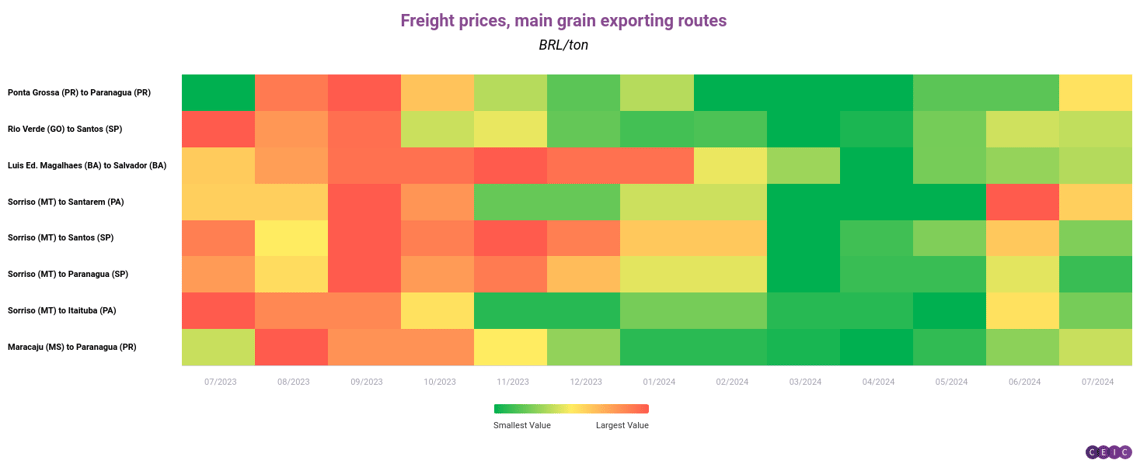
Our second chart is a heat map breaking down freight prices by route over recent months. The green cells recently show how freight prices appear to be consistently lower, regardless of region; for instance, routes originating from the key soybean state of Mato Grosso — located in the heart of the continent — saw reduced freight costs for northerly routes ending at the Amazon River ports of Santarem and Itaituba, as well as those terminating at the southern Atlantic ports of Santos and Paranagua.
If you are a CEIC user, access the story here.
If you are not a CEIC client, explore how we can assist you in generating alpha by registering for a trial of our product: https://hubs.la/Q02f5lQh0