CEICData.com © 2018 Copyright All Rights Reserved
.png?width=160&name=ceic-logo-Vector%20logo%20no%20tagline%20(002).png)

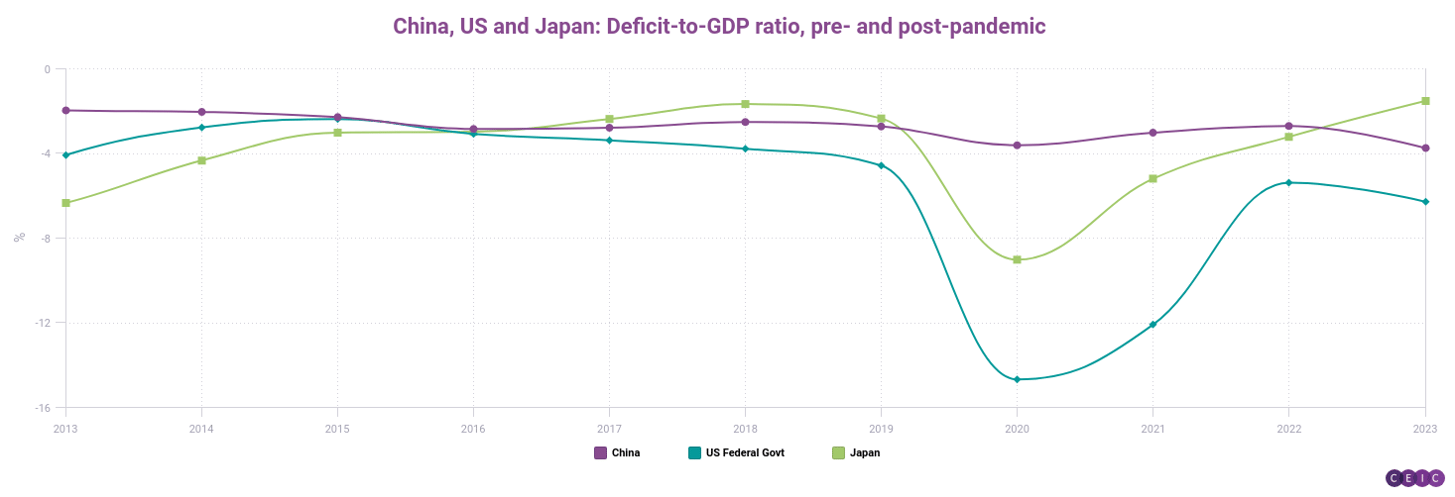
Before 2020, China's deficit-to-GDP ratio consistently remained below 3%. As the nation gradually rolls out more stimulus to support growth, that ratio has been increasing, but stands well below levels seen in advanced economies.
Our first chart tracks two measures of this debt metric and compares them to China's target.
-png.png?width=1464&height=501&name=Comparing%20two%20measures%20of%20Chinas%20deficit-to-GDP%20ratio%20(1)-png.png)
First, it's important to understand that China's budget system is known as the "four accounts:" 1) the general public budget, 2) government-managed funds, 3) state-owned enterprises' funds, and 4) social security funds.
We defined China's "broad deficit" as a combination of the general public budget and the government-managed funds. This moved more or less in line with the general budget deficit ratio until 2018, when it began significantly widening; as of 2023, the broad deficit was 6.1% of GDP, versus 3.8% for the "narrow" definition that only includes the general government budget.
This widening has coincided with more intense US-China trade friction, more uncertain external demand, and the increased importance of stimulus, special debt financing and spending measures – as well as borrowing by sub-national governments (a topic we have covered before); these measures have generally fallen into the government-managed funds segment.
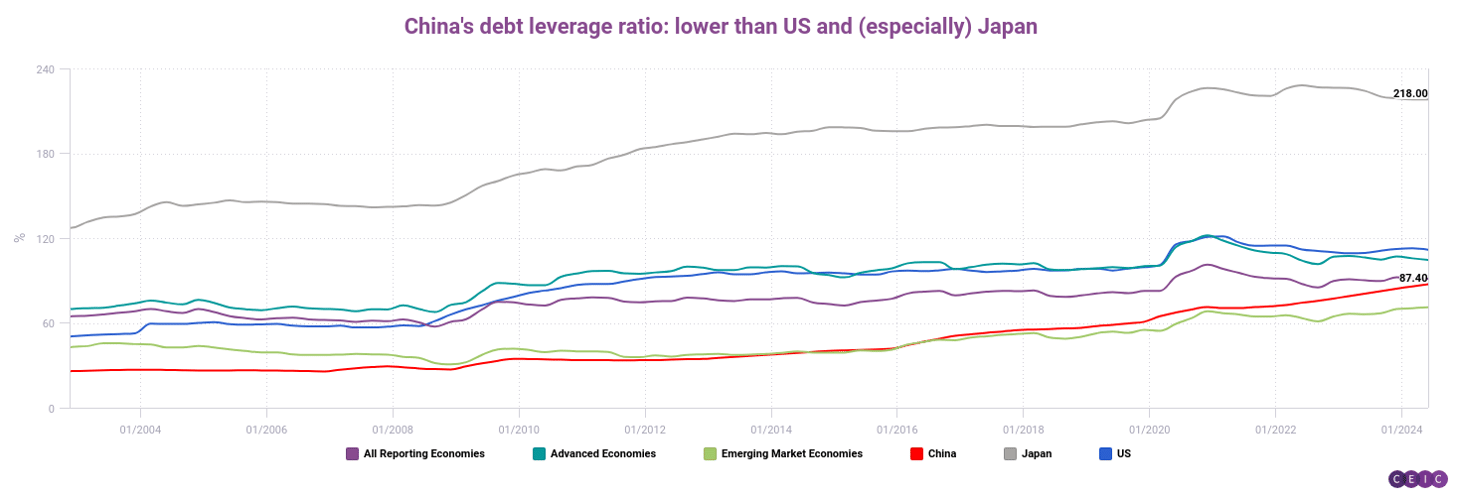
For international context, we've charted China's "narrow" deficit-to-GDP ratio against its US and Japanese equivalents, which widened far more during the pandemic. Japan's ratio is now the lowest of the three, though of course its longer-term debt burden is much higher than that of China or the US.
If you are a CEIC user, access the story here.
If you are not a CEIC client, explore how we can assist you in generating alpha by registering for a trial of our product: https://hubs.la/Q02f5lQh0