CEICData.com © 2018 Copyright All Rights Reserved
.png?width=160&name=ceic-logo-Vector%20logo%20no%20tagline%20(002).png)

.png?width=1070&height=366&name=Steel%20and%20aluminum%20the%20US%20is%20in%20the%20uncompetitive%20quadrant%20for%20both%20(1).png)
One of Donald Trump's rationales for his tariffs is that many countries behave unfairly as trading partners. But an analysis of industries the president has focused on suggests that for steel, aluminum and cars, the US is likely just structurally uncompetitive.
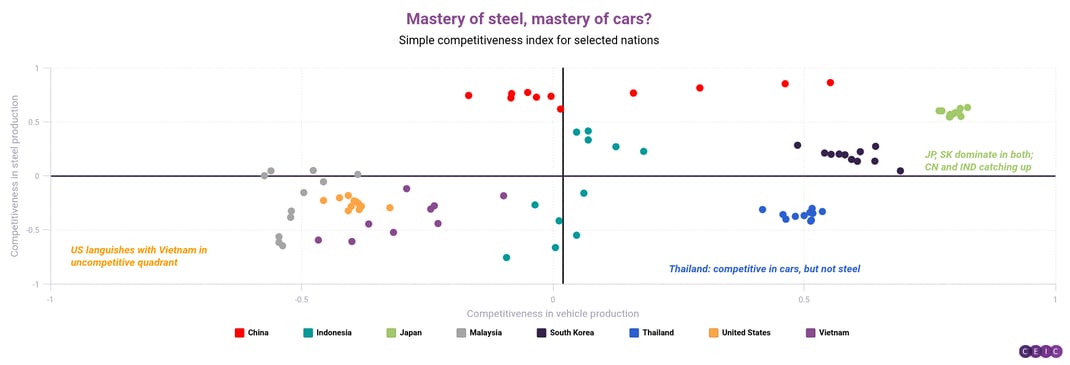
We've visualized a Simple Competitiveness Index (SCI) for the US and selected Asian economies when it comes to steel and aluminum. This calculation subtracts the value of imports from exports, and then divides that figure by the total of exports plus imports. We charted readings over the past decade.
The SCI ranges from -1 to +1. Positive values indicate that a country is a net exporter of a given product, signaling greater competitiveness. Negative values suggest a net importer position: higher reliance on foreign supply and relatively weaker competitiveness. The closer the index is to +1, the stronger the export position; the closer it is to -1, the greater the import dependence. While it doesn't capture a country's potential to improve its position, this simple model at least enlightens us on where countries stand at a given moment and in the recent past.
China's dominance in both steel and aluminum is evident. Interestingly, Malaysia appears to be catching up. And the US appears structurally uncompetitive in both steel and aluminum, despite having imposed tariffs of up to 50% on these products. Indonesia is also notable, moving up the value chain as it became a net steel exporter.
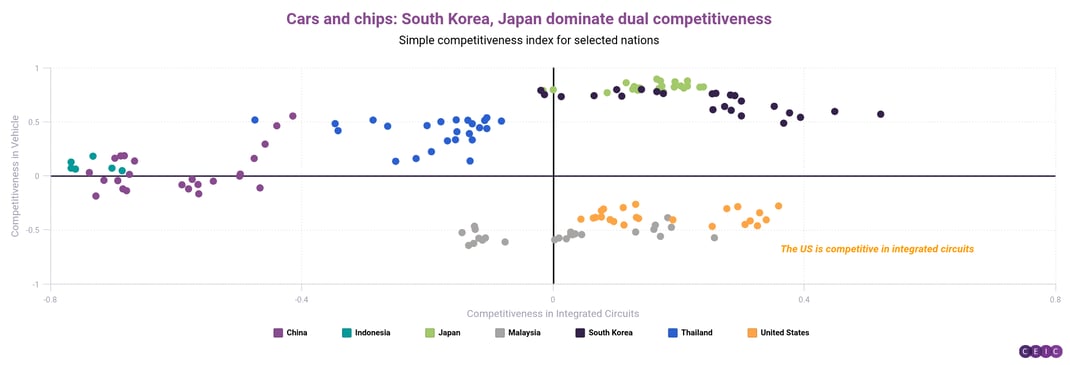
We've also created two-industry competitive quadrants for cars and semiconductors (where South Korea and Japan demonstrate strong competitiveness in both, leaving them particularly exposed to US tariff threats) as well as cars and steel. In the latter, the US closely resembles Malaysia: competitive in integrated circuits, but not autos. China continues to rely heavily on chip imports, but has rapidly gained competitiveness in cars as its EV sector boomed.
Of course, Trump has other goals with his policies, rather than just punishing perceived unfair traders. Amid widening budget deficits, tariffs are a source of income for the government; meanwhile, reshoring America's industrial capacity is viewed as crucial amid geopolitical concerns and the supply-chain shocks that followed the pandemic.
Click here to read about how China dominates resilient steel and aluminum production.
If you are a CEIC user, access the story here.
If you are not a CEIC client, explore how we can assist you in generating alpha by registering for a trial of our product: https://hubs.la/Q02f5lQh0