CEICData.com © 2018 Copyright All Rights Reserved
.png?width=160&name=ceic-logo-Vector%20logo%20no%20tagline%20(002).png)


After decades of massive projects, China's relative lack of new construction is weighing on investment indicators.
Fixed asset investment (FAI) is a key indicator for assessing how much a country is spending on long-term projects. We've broken out three broad, major subsectors of FAI In China and compared them to the total in our first chart: manufacturing facilities, infrastructure investments and real estate.
(CEIC's calculations and data curation allow us to re-chart FAI figures released on a year-to-date basis as rolling, year-on-year percentage change.)
Total FAI tipped into negative growth this year; manufacturing, infrastructure and property investment are all experiencing a simultaneous decline. (On a cumulative, year-to-date basis, It's the first time growth has turned negative since the pandemic shock.)
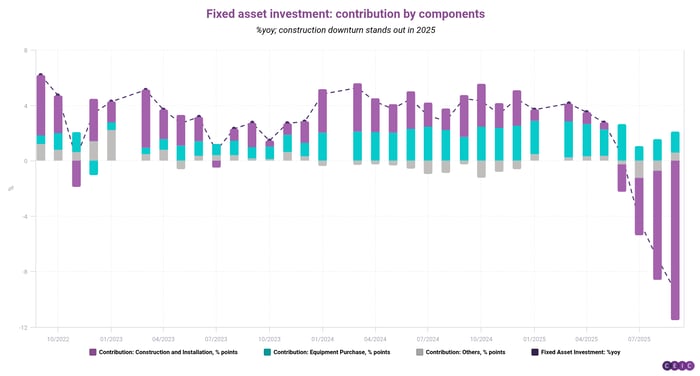
The property sector, which had been under pressure for some time, has fared worst: it posted the steepest decline in our chart. But as our second chart shows, construction has emerged as the biggest drag on FAI this year.
Investment in newly planned projects has fallen significantly, with two consecutive years of negative growth in this area, as our third chart shows.
The problem is likely not a funding issue but a shortage of high-quality projects appealing enough to attract major private capital. Weak demand and low investment returns have dampened corporate investment appetite; meanwhile, some firms are redirecting funds toward servicing existing debt.

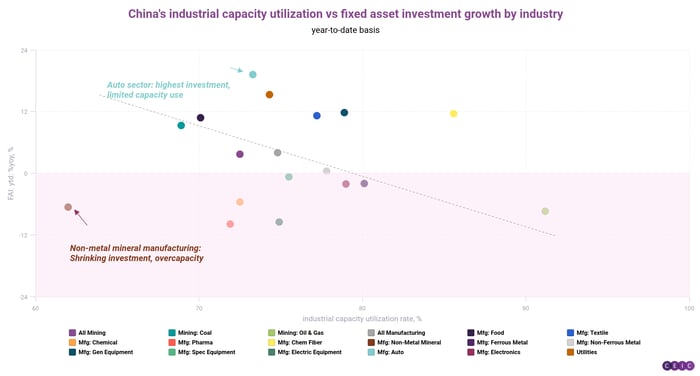
Our final scatterplot takes a deeper dive into individual industries. Auto manufacturing continues to attract significant investment despite low capacity utilization, likely driven by policy support for new energy vehicles.
Conversely, traditional heavy industries such as non-metal mineral manufacturing (e.g., cement, glass, ceramics -- all used in construction) are stuck in low capacity utilization and negative investment growth. Overcapacity and suppressed profitability persists.
If you are a CEIC user, access the story here.
If you are not a CEIC client, explore how we can assist you in generating alpha by registering for a trial of our product: https://hubs.la/Q02f5lQh0