CEICData.com © 2018 Copyright All Rights Reserved
.png?width=160&name=ceic-logo-Vector%20logo%20no%20tagline%20(002).png)

.png?width=1140&height=390&name=Intels%20perceived%20creditworthiness%20improves%20following%20report%20of%20US%20stake%20(1).png)
The US government could become beleaguered chip giant Intel's biggest shareholder -- the latest unconventional move in the Trump administration's push to make semiconductors a focus of national-security policy.
Using our data on the credit-default swap market, we've charted how perceptions of Intel's creditworthiness have sharply improved since the first reports of a US equity stake surfaced on August 14. In recent years, rival Advanced Micro Devices has been a more financially robust company than Intel, and the two companies' CDS were priced accordingly.
But the spread has narrowed -- and contracted even further after a vote of confidence from Japan's SoftBank, which announced a USD 2 billion investment in Intel.
An icon of the personal-computer boom from the 1980s on, Intel has struggled to keep pace with chipmaking rivals such as AMD and Nvidia that are benefiting from the rush to power artificial intelligence. Indeed, just days before reports of the potential government stake, Fitch Ratings had downgraded Intel with a negative outlook, citing slowing profitability growth and more intense competition.
Despite its problems, Intel remains one of few American companies capable of producing advanced semiconductors at scale, and the nation's largest employer in the sector. The deal with the US would potentially see Intel's CHIPS Act funding converted into a non-voting 10% equity stake; direct government ownership stakes in private companies are common in Europe and elsewhere, but are historically unusual Stateside. Intel's factory in Ohio (the home state of Vice-President J.D. Vance) was one of the most heavily funded projects under the CHIPS Act, but construction has stalled -- another impetus for the Trump administration's move.
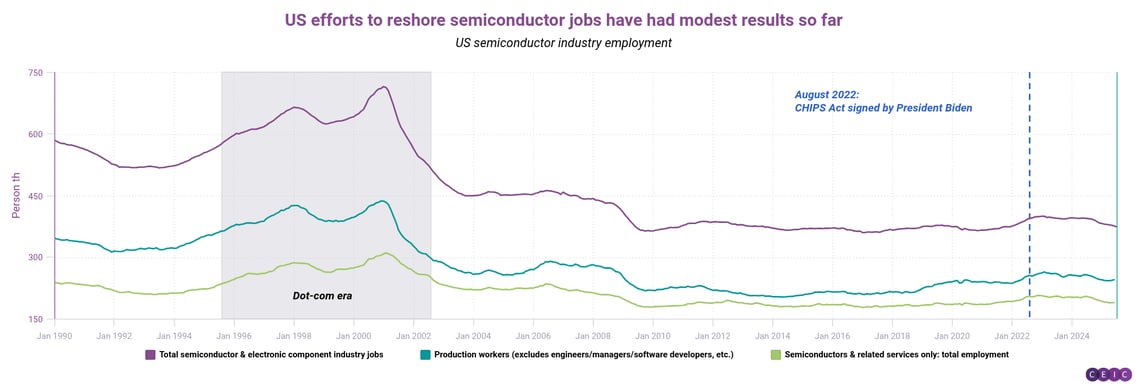
We've added two more charts showing the long-term context for US strategic support of this industry (which has been bipartisan; the 2022 CHIPS Act, with its reshoring focus, was an initiative of the Biden administration).
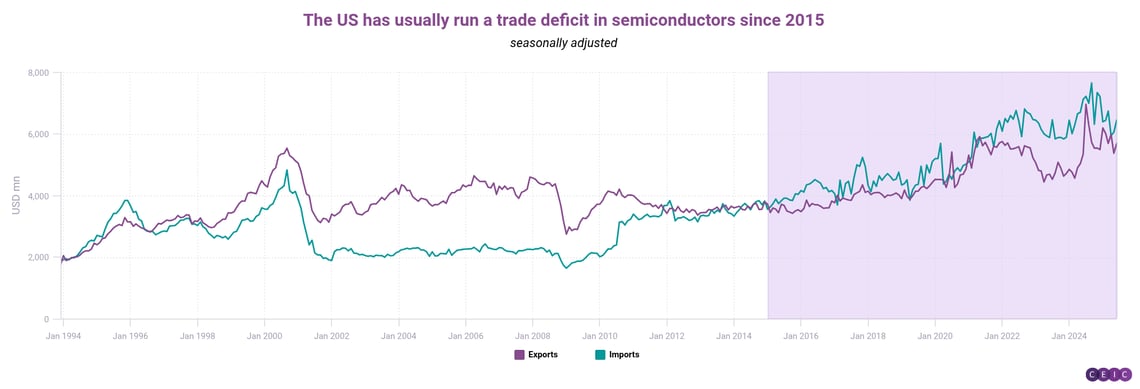
The first tech boom saw soaring employment in US chipmaking. Due to the long-term globalization of the supply chain, that has gradually dwindled -- with only a small upturn in 2023. Meanwhile, the long-term US trade surplus in semiconductors flipped to a deficit in the early part of the last decade, demonstrating the increased dependence on foreign chips.
Click here to read about China-US chip trade amid export restrictions and Nvidia's Trump deal.
If you are a CEIC user, access the story here.
If you are not a CEIC client, explore how we can assist you in generating alpha by registering for a trial of our product: https://hubs.la/Q02f5lQh0