CEICData.com © 2018 Copyright All Rights Reserved
.png?width=160&name=ceic-logo-Vector%20logo%20no%20tagline%20(002).png)

.png?width=1650&height=1050&name=The%20OER%20measure%20of%20US%20shelter%20costs%20previous%20slowdowns%20coincided%20with%20crises%20(1).png)
When it comes to measuring inflation, the cost of shelter is a key -- and sometimes controversial -- component. Given that property prices are considered to reflect an investment rather than consumption, the US Bureau of Labor Statistics compiles "owner's equivalent rent:" surveying what homeowners might hypothetically pay to lease their properties. This component accounts for about 26% of the overall US consumer price index.
For various reasons,* OER's critics say this method potentially distorts inflation, and some observers prefer to look past the shelter component when assessing the trajectory of consumer prices (and, thus, monetary policy). However, September US inflation data came in slightly lower than economists expected -- drawing attention to an unusually weak OER figure that broke from recent trends.
We've charted OER over the past two decades. In September, annualized month-on-month growth slowed sharply to 1.6% from August's 4.7% rate. The only similar occasions for such a slowdown in recent decades were the GFC and the pandemic.
How meaningful is that sharp slowdown? Is it an outlier versus broadly sticky inflation (3% overall CPI growth in September was still the most since January), or does it buttress the case for more rate cuts? For more insight, we've compared OER to alternative data on housing courtesy of Zillow, the popular US real-estate site.
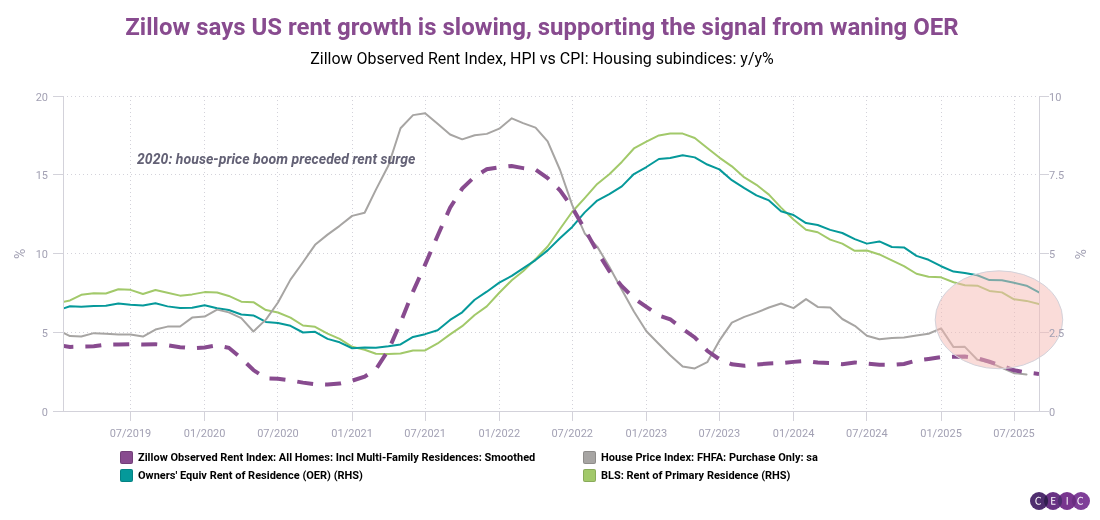
As our second chart shows, Zillow's rental indices are slowing down; house-price growth is also moderating. (Observed rental price data such as Zillow's has historically served as a leading indicator for OER changes.)
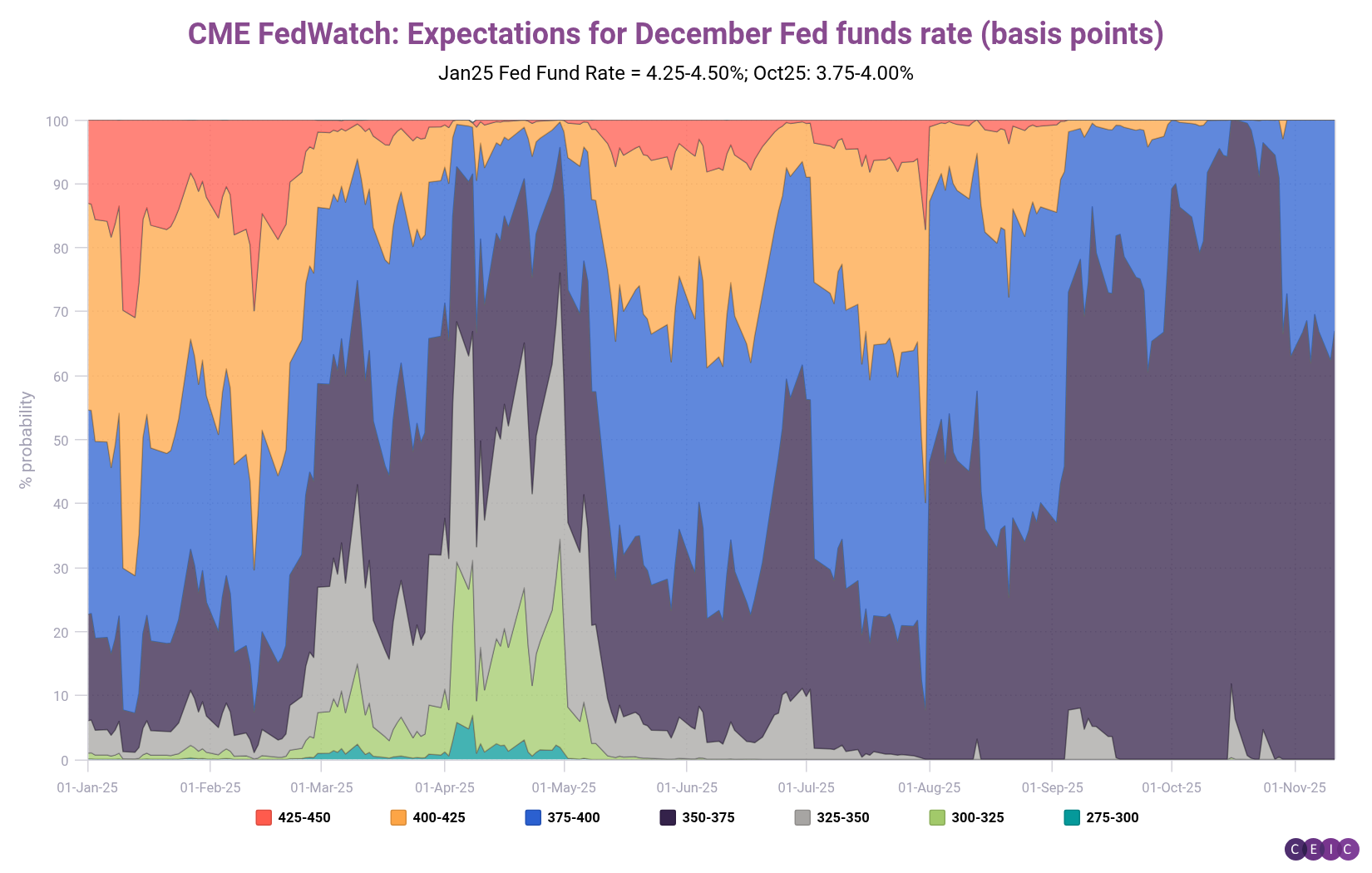
Finally, we note that the 3% September inflation print nevertheless tempered rate-cut expectations. In the days after the data's Oct. 24 release, the CME's FedWatch tool showed a slight but growing probability that the Fed's key rate would stay at 3.75-4.00% after the December FOMC meeting. This was reinforced by Jerome Powell's relatively hawkish messaging after the Fed's Oct. 29 rate cut; futures markets recently priced in a probability of 38% that the Fed will stand pat.
*OER is the result of estimates of the changes in rents on similar dwellings; critics point to the relative lack of single-family detached homes (the traditional US homeownership norm) to rent. The BLS abandoned a previous measure based on the price of new homes and monthly mortgage payments in 1982.
.png?width=1650&height=1050&name=OER%20shelter%20costs%20have%20been%20gradually%20easing%20in%202024-25%20September%20slowdown%20knocked%2001%20off%20total%20inflation%20(1).png)
Investment in newly planned projects has fallen significantly, with two consecutive years of negative growth in this area, as our third chart shows.
The problem is likely not a funding issue but a shortage of high-quality projects appealing enough to attract major private capital. Weak demand and low investment returns have dampened corporate investment appetite; meanwhile, some firms are redirecting funds toward servicing existing debt.
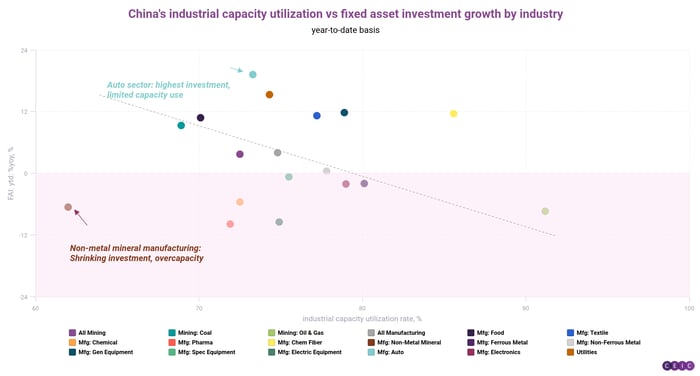
Our final scatterplot takes a deeper dive into individual industries. Auto manufacturing continues to attract significant investment despite low capacity utilization, likely driven by policy support for new energy vehicles.
Conversely, traditional heavy industries such as non-metal mineral manufacturing (e.g., cement, glass, ceramics -- all used in construction) are stuck in low capacity utilization and negative investment growth. Overcapacity and suppressed profitability persists.
If you are a CEIC user, access the story here.
If you are not a CEIC client, explore how we can assist you in generating alpha by registering for a trial of our product: https://hubs.la/Q02f5lQh0