CEICData.com © 2018 Copyright All Rights Reserved
.png?width=160&name=ceic-logo-Vector%20logo%20no%20tagline%20(002).png)

.png?width=1140&height=390&name=International%20comparisons%20suggest%20Chinas%20consumers%20still%20have%20potential%20to%20spend%20more%20(1).png)
China has long been looking to pivot to domestic consumer spending as a pillar of the economy, easing dependence on manufacturing exports. Subsidies for spending on digital goods and appliances were part of this year's stimulus measures, for instance.
We explored how Chinese consumers have more potential to boost the economy by spending on services as well as goods.
Our first chart compares Chinese "final consumption" as a share of GDP to neighboring South Korea and Japan, as well as the US, the eurozone and broad aggregates of middle- and high-income economies. Final consumption includes both households and government spending; it accounted for about 57% of China's GDP in 2023, versus 68% in South Korea and more than 80% in the US.
By this metric, China's long-term trend has also seen more change than other nations: roughly in line with Japan and South Korea as recently as 1991, final consumption fell to a low of about 50% of GDP in 2010 following a booming decade of industrialization and export-driven growth. Since then, consumer and government spending have regained relative importance in the economy.
As we wrote several months ago, the structure of Chinese consumption has also steadily changed. Less than three decades ago, food accounted for almost half of household spending; as that share has fallen, Chinese consumers have been able to spend more of their income on services, such as healthcare and tourism.
We explore the particularities of the service sector in our second chart, which uses input-output analysis*. It breaks down the portion of output that flows into three "final use" categories: exports, domestic consumption and gross capital formation, i.e. investment-related activities.
Overall, almost 80% of services final use flows directly into consumption. This compares to mining- and industrial-related sectors, which have a much greater export component. Construction work results in buildings or infrastructure, i.e. gross capital formation.
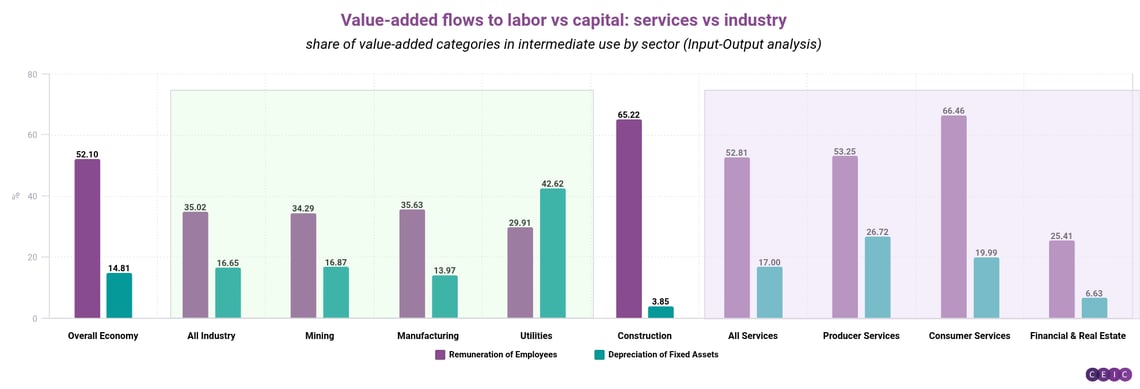
Our third chart shows how services play a significant role in the national income distribution. More than 50% of this category's value added is directed to wages and salaries versus replacing fixed assets -- far higher than is the case for manufacturing.
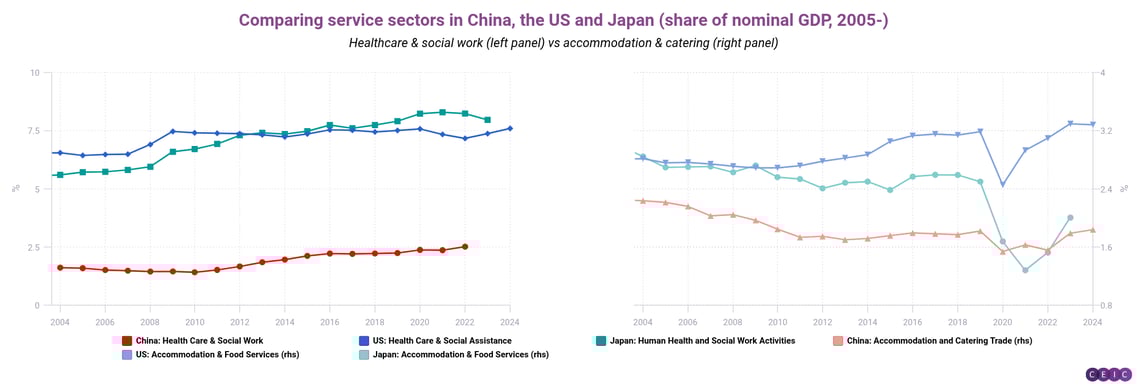
Chinese spending on entertainment, health and elder care still lags behind OECD averages. For instance, the healthcare and social work service sector accounts for only 2.5% of China's GDP, far below 7% or more as seen in the US and Japan -- as we demonstrate in our final chart. Similarly, the share of hospitality services is lower than in developed economies.
China wants the services sector to create a virtuous, sustained cycle for economic growth. Given its effect on boosting household incomes, the service sector has the potential to enhance the entire nation's
Click here to read about China's consumption changes.
If you are a CEIC user, access the story here.
If you are not a CEIC client, explore how we can assist you in generating alpha by registering for a trial of our product: https://hubs.la/Q02f5lQh0