CEICData.com © 2018 Copyright All Rights Reserved
.png?width=160&name=ceic-logo-Vector%20logo%20no%20tagline%20(002).png)

Donald Trump's "Liberation Day" tariffs and other policies shook conventional wisdom about the US dollar and the structure of the global financial system. Post-World War II assumptions about geopolitics, Federal Reserve independence and the global reserve currency were upended.
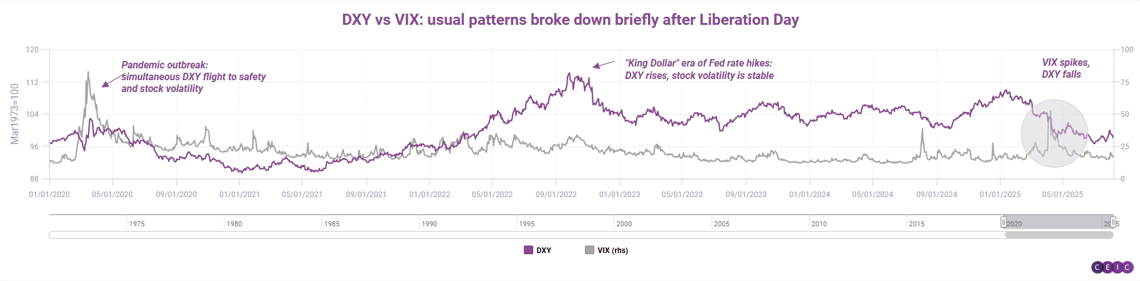
The greenback usually benefits from a flight to safety in times of market turmoil; instead, investors pivoted away from US assets and the dollar fell.
Four months after the Trump shock, have market perceptions of the dollar returned to the old, "safe haven" normal? Our regression analysis suggests they have -- and identifies how long a "Trump structural break" lasted.
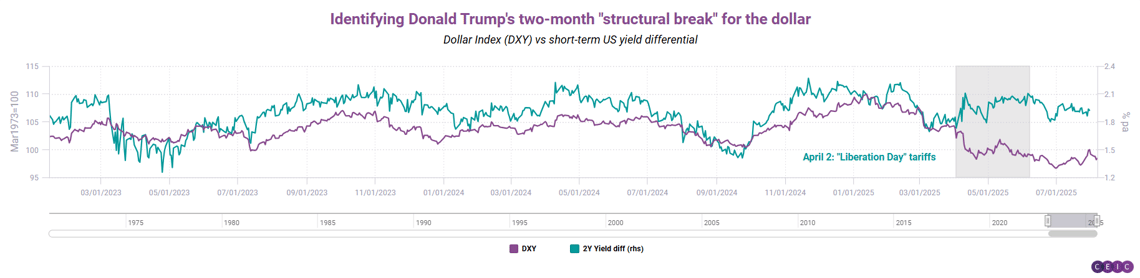
The Dollar Index (DXY) measures the greenback against the currencies of major US trading partners. Its key driving factors typically include yield differentials, risk aversion, and global liquidity.
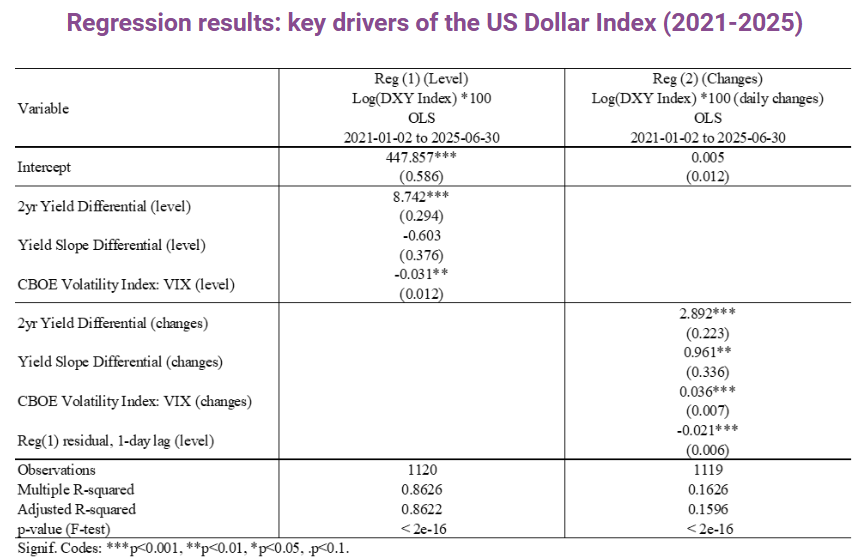
CEIC selected the logarithmic level of DXY (multiplied by 100) as the dependent variable and used the following variables as independent variables: the 2-year government bond yield differential between the US and other major economies (Germany, Japan, the UK, Canada, Sweden, and Switzerland, weighted by the composition of the Dollar Index), the yield curve slope differential (the slope of the US 10-year curve, minus 2-year government bond yields compared to the weighted average slope of other major economies), and the CBOE Volatility Index (VIX).
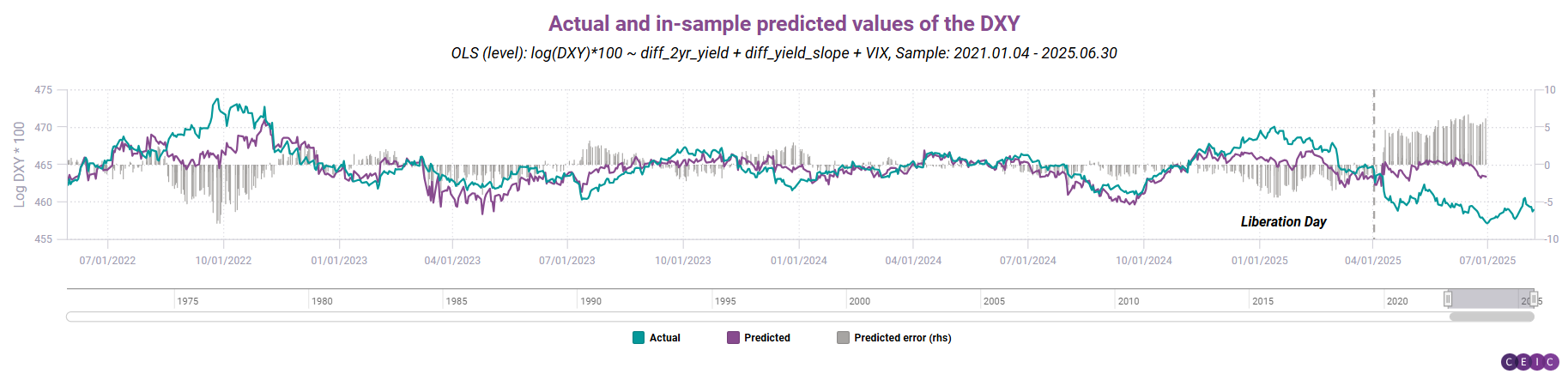
After conducting a regression analysis on the 2021-2025 period, we found that short-term yield differentials between the US and other major economies are the key driving factor for DXY over the long term, and we've charted this in our first visualization.
And by comparing the in-sample predicted values of our models with the actual values, we identified when our models stopped performing well. They missed two key turning points.
For example, in the months following the US election in November 2024, DXY significantly exceeded the model's predicted values, likely reflecting a "Trump trade." And after "Liberation Day," DXY performed notably weaker than the model predicted: trade uncertainties led to a structural break between the Dollar Index and its driving factors.
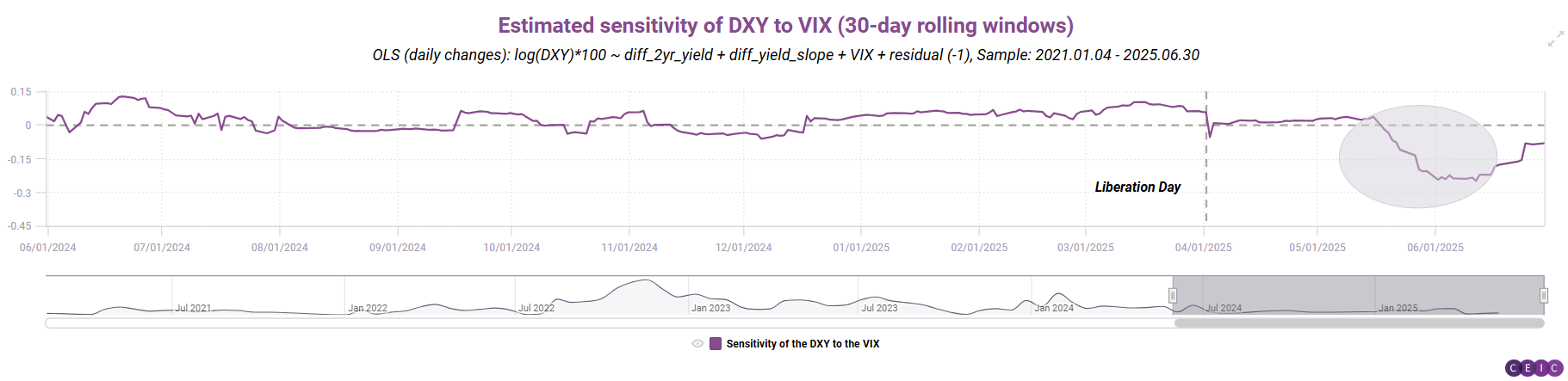
In the shorter term or for intraday trading, DXY is additionally influenced by the VIX -- the most common measure of stock-market volatility. This captures the "safe-haven effect." Our second chart highlights both a typical episode of risk aversion -- VIX and DXY spiking in unison during the pandemic outbreak -- and the atypical "Liberation Day" period when volatility spiked and the dollar fell. And our final chart, we dynamically estimate the sensitivity of DXY to VIX -- identifying a post-Liberation Day period where the dollar in fact behaved as a risk-seeking currency.
Since early June, the dollar's sensitivity to the VIX has returned to its usual range. While the US President may have more surprises in store, it appears the dollar's safe-haven status has been restored.
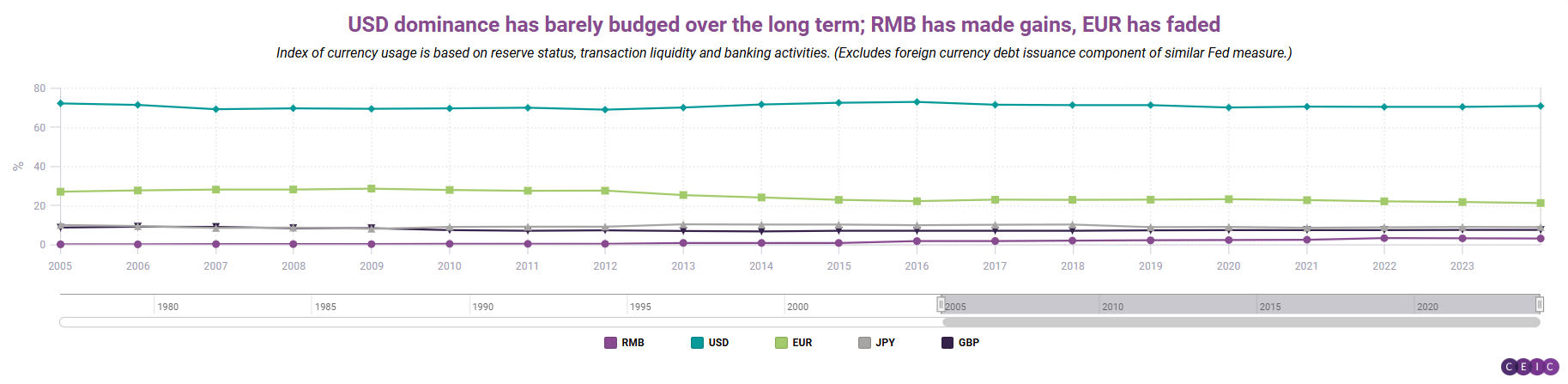
We've added a further chart on the long-term dominance of the dollar versus other currencies. (We based our approach on the Federal Reserve's Index of International Currency Usage, but excluded the Fed's use of foreign currency debt issuance. Our index assigns a 33% weighting to the share of each currency in global forex reserves and forex transaction volumes; the remaining third is divided between use in foreign currency international banking assets and foreign currency international banking liabilities (16.67%). Unlike the Fed's index, our version does not include foreign currency debt issuance as a component.
The results show that since 2005, the US dollar has consistently maintained a significantly higher level of international usage compared to all other currencies. The euro ranks second, but has slipped over the longer term; international use of the Chinese yuan has been inching higher.
We invite you to contact us for more details on our models for DXY and reserve-currency use.
This study employs two models. Reg (1) is based on the "level" and examines the long-term equilibrium relationship between DXY and its primary driving factors. Reg (2) is based on "daily changes," capturing the short-term dynamics of DXY while introducing an error-correction term to analyze the adjustment process following short-term deviations from equilibrium.
Two academic papers inspired this analysis:
[1] Bertaut, Carol, Bastian von Beschwitz, and Stephanie Curcuru (2025). "The International Role of the U.S. Dollar – 2025 Edition," FEDS Notes. Washington: Board of Governors of the Federal Reserve System, July 18, 2025, https://doi.org/10.17016/2380-7172.3856.
[2] Kamin, S. B. (2025). Dollar Movements and Dollar Dominance in the Aftermath of Liberation Day (AEI Economics Working Paper 2025-06). American Enterprise Institute.
Click here to read about investors pivoted away from US assets and the dollar fell.
If you are a CEIC user, access the story here.
If you are not a CEIC client, explore how we can assist you in generating alpha by registering for a trial of our product: https://hubs.la/Q02f5lQh0