CEICData.com © 2018 Copyright All Rights Reserved
.png?width=160&name=ceic-logo-Vector%20logo%20no%20tagline%20(002).png)

China-US trade-dependent sectors -- from apparel to machinery and more (January 16 2025)
Our most-read data story was one of the year's first. With Donald Trump days from inauguration, we assessed industries where the incoming US president might have a particularly disruptive effect on US-China trade -- and, as it turned out, there has been a visible impact already.
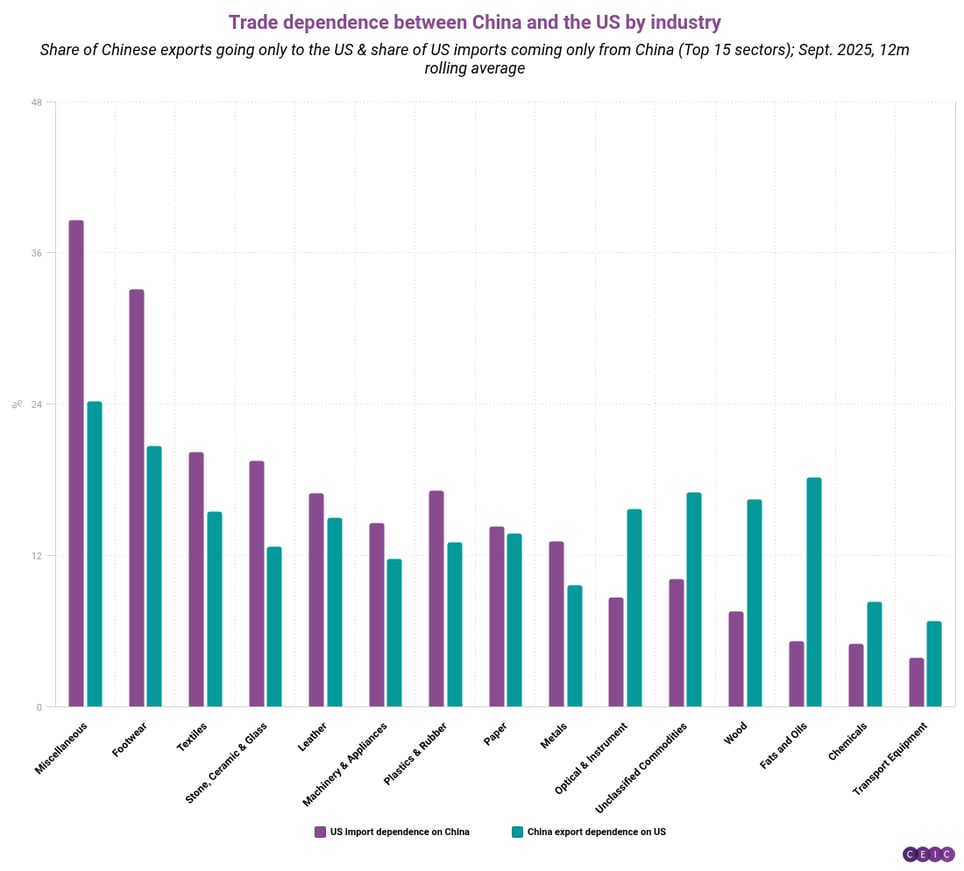
We charted the US sectors with the most exposure to Chinese imports, as well as the Chinese sectors most reliant on the US market as delineated by the US harmonized tariff schedule (HTS).
Apparel figured strongly (as does the "miscellaneous" category that includes toys and furniture). In January, about 40% of US shoe imports (on a 12-month rolling basis) came from China; meanwhile, the US accounted for 23% of China's shoe exports.
We've republished this chart with figures to September -- showing how it has already changed from the figures mentioned above. (We invite you to toggle the date between months to watch how quickly the US and China lessened their mutual trade dependence.)
The share of US footwear imports from China fell to 35%; Chinese footwear exports destined for the US fell to 20%. Also consider the "fats and oils" category: 30% of China's exports headed to the US as of January, but that was down to 18% by September.
Clicking through to the original data story breaks down this trade relationship by absolute value, the value of US machinery and appliance imports from China, and China’s exports in that sector to other markets.
We deployed newly added tariff data that was based on Harmonized System (HS) 8-digit and 10-digit codes.
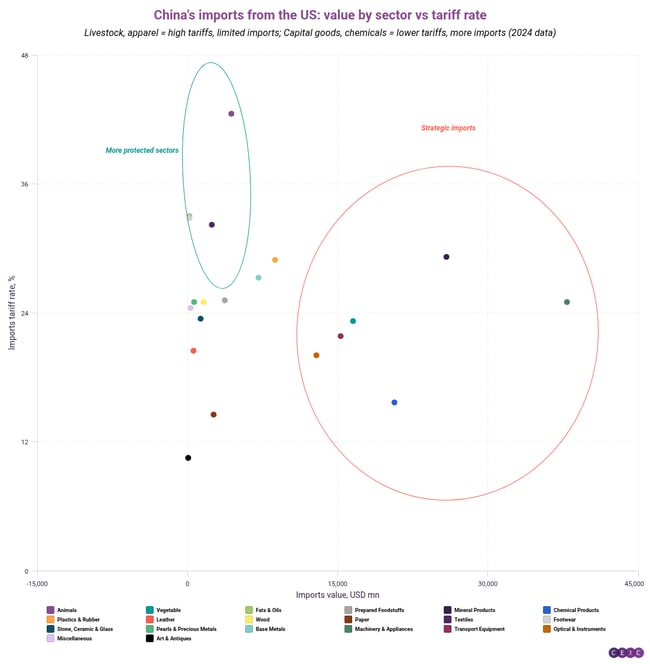
While Donald Trump's tariffs on China made headlines weekly, China's own levies on imports from the US are equally of note.
China uses this tool of trade policy to protect industries where it believes the nation is self-sufficient, while keeping tariffs lower on sectors where US imports are viewed as key to an overall development strategy.
Animal products, fats & oils and apparel have the highest average tariffs. By contrast, US-made machinery and equipment face relatively moderate tariffs, but their import value is the highest. China's own manufacturers use these high-value-added capital goods to strengthen their own competitiveness and efficiency.
(The data is annual, so our chart still considers 2024 figures; their 2025 equivalents have yet to be published.)
Click here for the original data story
How China's trade dependencies evolved in a higher-tariff era (July 17 2025)
We deployed our historic data to measure how China's trade relationships changed over 10 years, including the lingering impact from Donald Trump's first term.
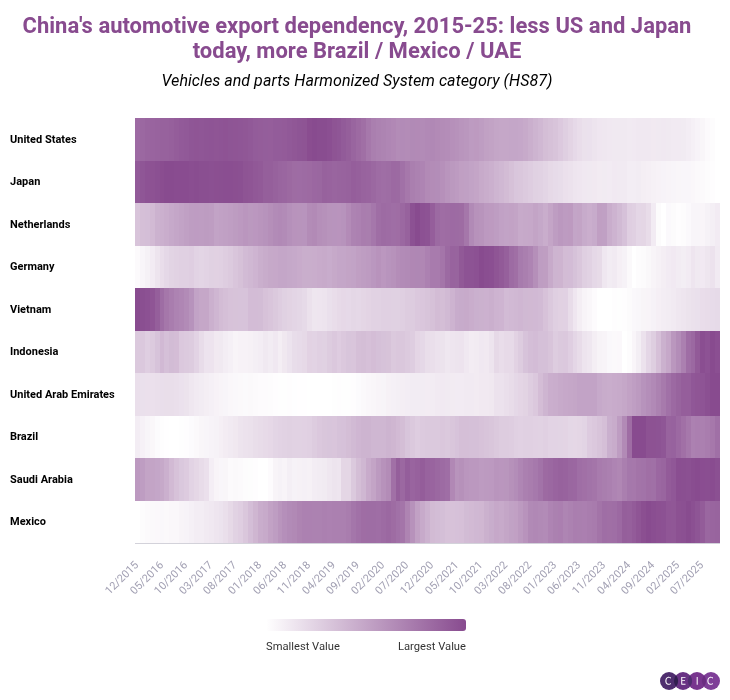
Looking at the automotive industry reveals that China's exports were quite dependent on the US and Japan in 2015. Latin American markets and the oil-rich Persian Gulf monarchies were of much less importance.
By 2025, those trends had completely reversed. (With five more months of data added since its original publication, this heat map is little changed.)
Clicking through to the original data story will provide more visualizations related to Trump's 2018-19 tariffs, changing destinations for electric-vehicle exports and the China-Vietnam trade relationship.
Measuring global competitive advantage (29 August 2025)
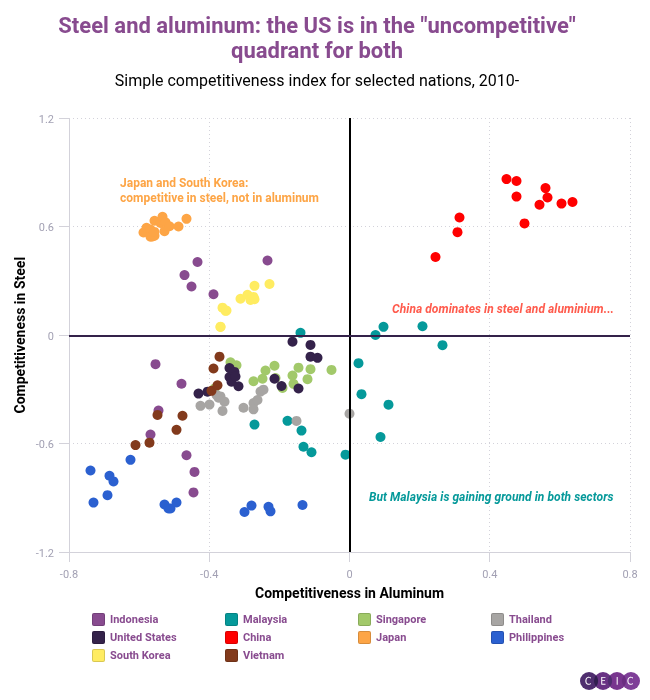
With steel and aluminium in Donald Trump's crosshairs, we created a simple competitive index (SCI) for the US and selected Asian economies, including the ASEAN nations, Japan and Korea.
This calculation subtracts the value of imports from exports, and then divides that figure by the total of exports plus imports. Positive values on the chart indicate that a country is a net exporter of a given product, signalling greater competitiveness; negative values suggest a net importer position reliant on foreign supply.
The scatterplot charts readings over more than a decade. One of the US president's rationales for his tariffs is that many countries behave unfairly as trading partners -- but this analysis suggests that often, the US is just structurally uncompetitive.
Clicking through to the original data story will open similar visualizations for the chip and auto sectors.
China's increasing orientation to emerging-market trading partners (25 September 2025)
China's rise to become the world's manufacturing powerhouse was associated with exports to Western markets, starting in textiles and moving up the value chain. But today, exports to emerging markets are growing much more quickly.
We tracked this long-term reversal, indexing EM and developed market exports in USD terms to mid-2018, when the first Trump administration imposed tariffs on China. Growth trends for EM and DM exports diverge in 2019.
Emerging markets have become key destinations for capital goods, components, and intermediate goods (i.e., goods used to make other goods). China's trade pivot is both a reactive adaptation to US moves and a proactive choice that targets growing, increasingly sophisticated countries with their own export sectors.
In the two months since we first published this chart, the EM line continues to tick higher while the DM line flatlines.
Clicking through to the original data story will open more visualizations on China's trade balance and a multi-chart look at Vietnam -- whose emergence as a key "connector economy" was a notable theme of our stories.

If you are a CEIC user, access the story here.
If you are not a CEIC client, explore how we can assist you in generating alpha by registering for a trial of our product: https://hubs.la/Q02f5lQh0