CEICData.com © 2018 Copyright All Rights Reserved
.png?width=160&name=ceic-logo-Vector%20logo%20no%20tagline%20(002).png)

CEIC recently added thematic datasets on the Belt and Road Initiative (BRI), China's signature international investment strategy. Over 12 years, the BRI has seen China help finance more than USD 1 trillion of projects in dozens of countries. As might be expected, these countries have taken on a greater role in China's trade; in turn, the BRI has helped boost yuan internationalization, a key goal for China.
Figures for 2025 show that nations involved in the BRI accounted for an increasing share of China's exports over the course of the year, averaging about 50%; the share of China's imports coming from BRI nations is even higher, averaging about 53% through 2025.

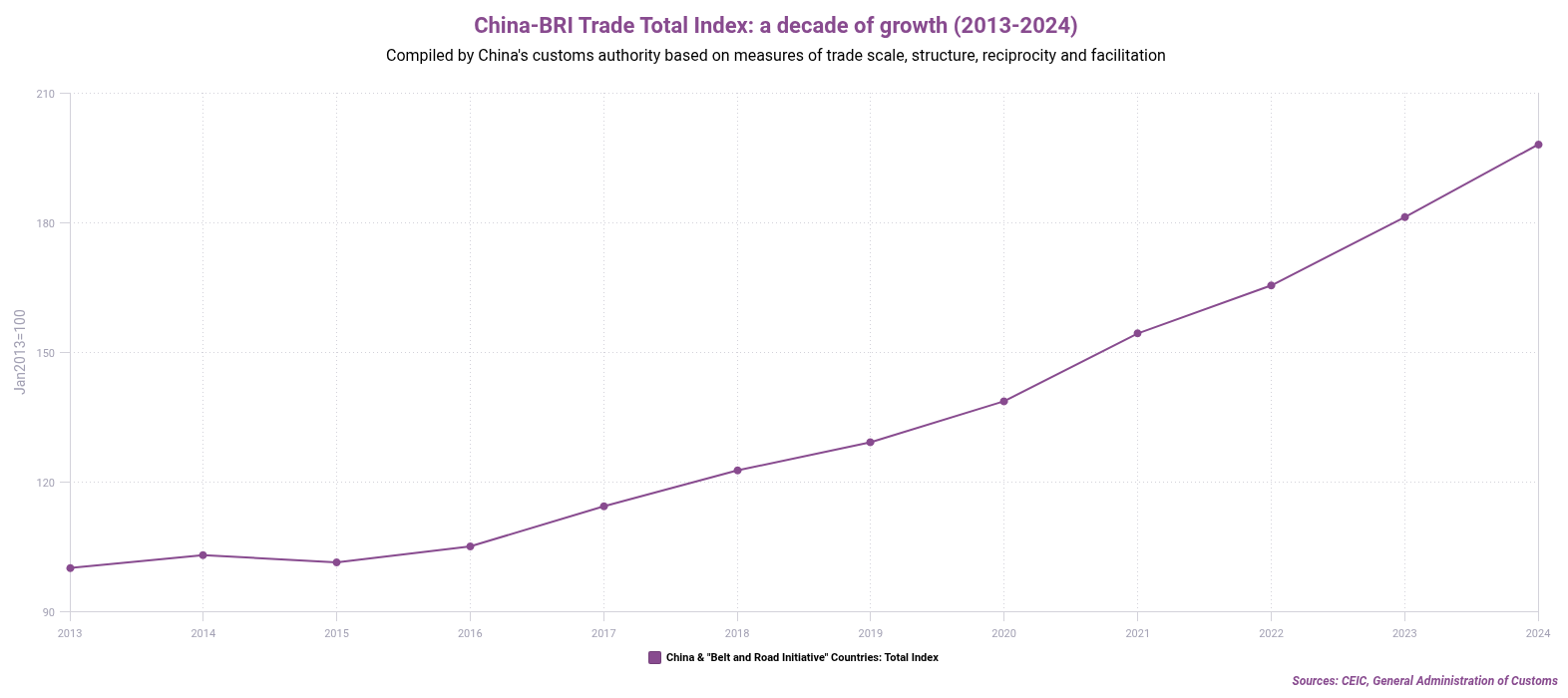
Our second chart visualizes the China-BRI Trade Total Index. This is calculated by the nation's customs administration, which tracks four of its own proprietary measures: "trade scale," "trade structure," "trade reciprocity" and "trade facilitation." From a base value of 100 when BRI was initiated in 2013, the index had doubled by 2024.
A key aspect of the BRI is large infrastructure projects, such as Indonesia's Jakarta-Bandung High-Speed Railway (completed in 2023). Our third chart examines Chinese companies' overseas projects, tracking the rising value of completed contracts and direct investment in BRI nations. In share terms, there is a notable uptick in 2023; the share of turnover from completed projects in BRI countries surged to over 80%. This reflects both the growing importance of the BRI trade relationships, but also more countries becoming "Belt and Road" partners.

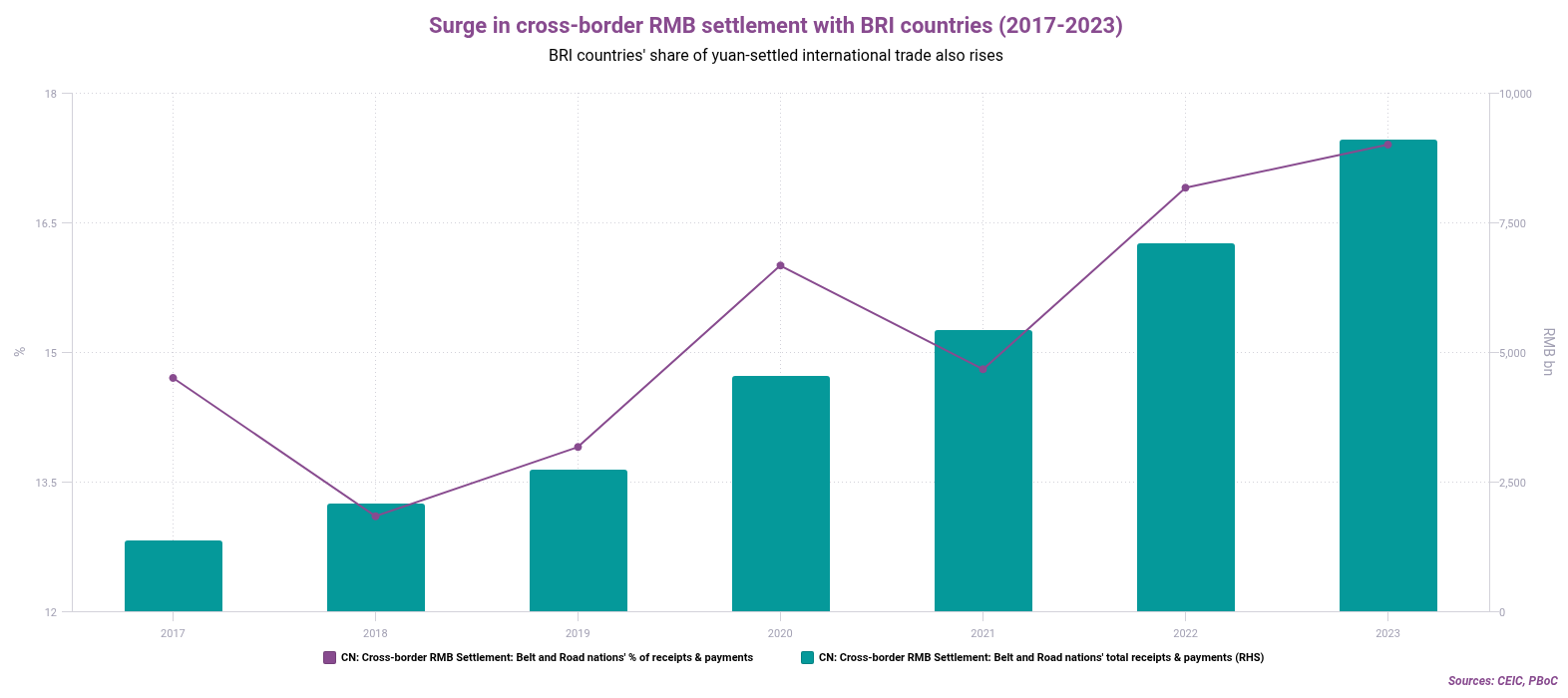
Finally, we look at cross-border transactions made in renminbi (RMB) by Belt and Road partner nations. These payments' value climbed more than sixfold in six years -- from 1.36 trillion yuan in 2017 to 9.1 trillion yuan in 2023 (about USD 1.3 trillion at today's exchange rate). And BRI nations' share of total cross-border RMB settlements rose from less than 15% in 2017 to 17.4% in 2023.
Our final pie charts break down the composition of those BRI yuan flows, comparing 2022 to 2023 figures. Settlement of trade in goods and services accounted for a rising share -- but also of note is the importance of the "other" category, which still accounted for almost 50% of the flow in 2023. This segment includes financial transactions and capital operations -- i.e. reflecting the yuan's role as an investment and reserve currency in BRI relationships, not just a vehicle of trade.

If you are a CEIC user, access the story here.
If you are not a CEIC client, explore how we can assist you in generating alpha by registering for a trial of our product: https://hubs.la/Q02f5lQh0