CEICData.com © 2018 Copyright All Rights Reserved
.png?width=160&name=ceic-logo-Vector%20logo%20no%20tagline%20(002).png)

A Perspective from ISI Markets, Drawing on the latest CEIC ASEAN Data
The shifting tectonic plates of the global economy, characterised by persistent trade fragmentation and the imperative of supply chain diversification, have elevated the Association of Southeast Asian Nations (ASEAN) into a new and definitive role: the "connector economy".
In this role, ASEAN has emerged as an important region linking global trade flows - of goods, services, investment, data, supply chains, energy, and talent - acting as a bridge between major economies and growth frontiers. For global businesses and investors, overlapping geopolitical shifts and rapid regional integration are turning ASEAN’s rise from a long-term theme into an urgent strategic reality.
The imperative for global firms is clear: they must move beyond tactical adjustments and structurally embed themselves in the region to capitalise on its long-term, secular growth trajectory. This is why the bloc’s growing internal coherence, driven by initiatives like the ASEAN Connectivity Strategic Plan 2026–2035 (ACSP) and the ASEAN Economic Community Strategic Plan 2026–2030 (AEC 2026-30), signals its intent to evolve from a loose collection of individual markets into a unified economic powerhouse. This strategic location reinforces its capability to function as a formidable economic bridge in a multipolar world.
Global Trade Dynamics: The Analytical Imperative of Supply Chain Bridging
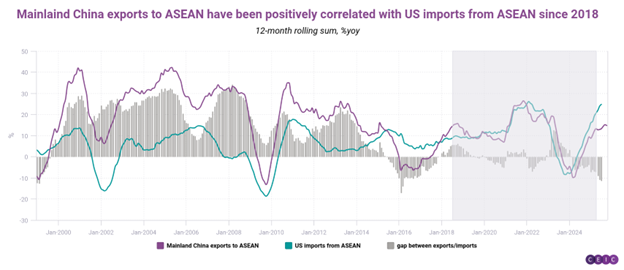
The empirical evidence of supply chain reconfiguration, driven by global firms diversifying production, is unequivocally clear in the data, positioning ASEAN as the natural diversification hub. This trend is quantified by an analysis of cumulative direct investment abroad by China since 2017, showing that Thailand, Malaysia, and Indonesia are experiencing the most notable trend changes in deviation from pre-2018 import trends, a material indicator of Foreign Direct Investment (FDI)-led manufacturing redirection. This validates ASEAN as the pivotal switching mechanism for global supply chains. The operational reality of this shift is best seen in the China-US-ASEAN trade triangle: the strong positive correlation between China's exports to ASEAN and US imports from ASEAN since 2018 illustrates ASEAN’s critical role as a processing and assembly centre, effectively bridging the two major global economies through intermediate goods and final products.
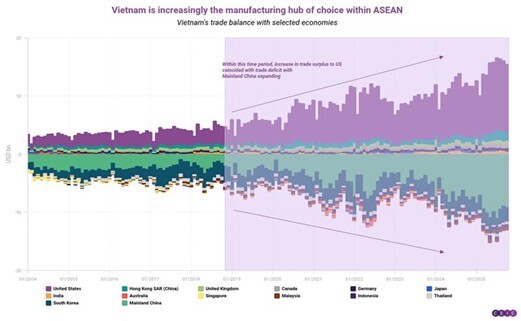
Analysis of recent trade and investment patterns reveals that geopolitical and tariff pressures are prompting a strategic pivot by China, aimed at preserving access to global markets through ASEAN’s expanding trade frameworks. Vietnam serves as a prime case study of this connector function. Its expanding trade surplus to the US coincided with an expanding trade deficit with China across the 2018 to 2024 period, demonstrating the classic pattern of trade diversion and upgrading. Furthermore, China's import dependency on Vietnam for electrical equipment (HS 85 category) is rapidly increasing, reflecting a rapidly rising bilateral dependency in core supply chains. This highlights that embeddedness in multiple global trade networks makes ASEAN a strategic necessity, not just a preference, for global production.
The automotive sector further exemplifies this industrial transition. Here, domestic market dynamics are intrinsically linked to global trade pressures. The Thai automotive industry is facing intense pressure from subdued domestic demand, with the share of industry output absorbed by the domestic market declining to below 40% since the pandemic, compelling a greater reliance on exports. This domestic softening coincides with competitive price pressure from new entrants: the fall in import prices for vehicles and parts since 2021 coincided with a surge in Chinese auto exports to Thailand, which surged roughly at the same time.
Simultaneously, Thailand is undertaking a structural pivot toward advanced manufacturing and the energy transition. Government policy has catalysed a surge in Electric Vehicle (EV) production capacity from 1% to 7% within an eighteen-month period, as seen from capacity coming online since 2024. Meanwhile, Malaysia has experienced strong vehicle sales, even surpassing Indonesia and Thailand in total units sold on a rolling basis across periods since 2024, underscoring the resilience of its domestic consumption base. In contrast, Vietnam’s motor vehicle sales have stagnated since 2019, reflecting its transitional position within the regional production network - where industrial upgrading is advancing rapidly, but domestic demand is yet to catch up.
Services, Energy, and Financial Stability: The Connectivity Corridors
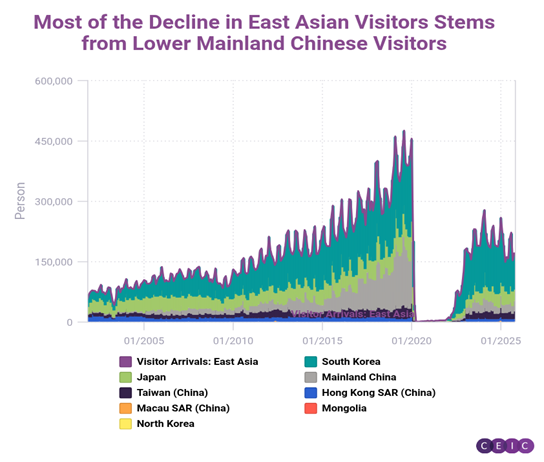
ASEAN’s role as a connector extends beyond the trade of goods to encompass the services that facilitate cross-border exchange - from logistics and finance to tourism. Among these, the recovery of tourism stands out as a core export flow. In Thailand, total visitor arrivals closely track exports of goods and services as a share of GDP, underscoring tourism’s direct contribution to external trade performance. Similarly, in the Philippines, despite fewer arrivals from East Asia — particularly from China — the Gross Value Added of Tourism Industries (GVATI) has fully rebounded from its pandemic low, highlighting resilient service demand and successful market diversification.
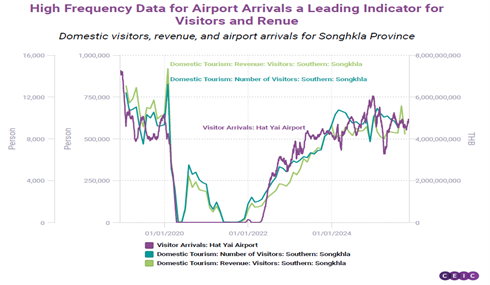
 Crucially, this accelerated economic activity directly translates into soaring utility demands. The service sector's need for energy is significant, with transport (43.52%) and services (22.76%) accounting for the largest share of petroleum demand in the Philippines. Simultaneously, the region is embracing the energy transition as a structural necessity. Singapore, for example, is driving double-digit growth in its Grid-Connected Solar Photovoltaic (GCSPV) System capacity, primarily led by Non-Residential users, demonstrating private sector commitment to sustainable infrastructure. Meanwhile, robust demand signals are evident in Thailand, where electricity consumption is finally recovering after contracting for most of 2025 so far.
Funding this vital infrastructure and maintaining macroeconomic resilience relies on financial stability. The banking environment reflects careful management and responsiveness to currency dynamics. In Malaysia, total outstanding Ringgit liquidity has been slowly shrinking, with the money-market component notably contracting since 2022. However, the central bank (BNM) has been concurrently winding down foreign-currency borrowing as the Ringgit appreciates in 2025, reflecting proactive measures to stabilise the currency. In Thailand, the fall in the 10-year government bond yield signals a general flight to a safe haven, reflecting a cautious stance on domestic risk appetite amidst global uncertainty.
The Bottom Line: Capitalising on a Pivot Year
The current environment, particularly with the global economy shifting toward a regionalised yet interconnected structure, confirms FY26 as a pivot year. The data provides the clarity and market intelligence needed to understand and capitalise on this transformation. ASEAN’s commitment to internal integration, coupled with its neutral stance and immense market scale of over 650 million people, positions it perfectly to be the ultimate connector economy, bridging supply chains, digital corridors, and energy transitions. This translates into secular growth opportunities across the region's key sectors.
The investment opportunities lie clearly in the accelerating supply chain reconfiguration, digital technology, and clean energy sectors. To capitalise, businesses must view ASEAN not as a collection of individual markets, but as a unified, essential bridge for global value chains.