CEICData.com © 2018 Copyright All Rights Reserved
.png?width=160&name=ceic-logo-Vector%20logo%20no%20tagline%20(002).png)

Aging populations are putting stress on social systems across developed markets, but Brazil is seeing some of the same demographic tendencies as certain European nations and Japan.
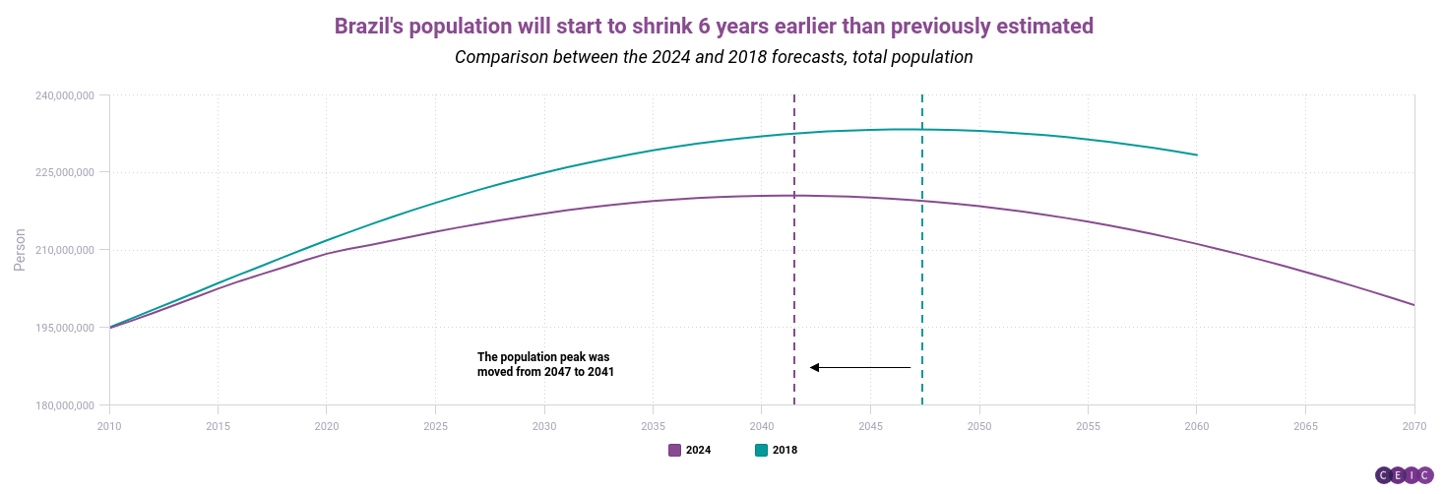
The nation's population is now expected to start shrinking in 2041 -- six years earlier than previously projected, according to recently released figures from the Brazilian Institute of Geography and Statistics (IBGE). The institute updated its estimates for the first time since 2018, and assessed the changes to come in the next 45 years.
As of 2023, Brazil had 146 million working-age people and 23 million individuals aged 65 older -- i.e., 6.3 potential active workers per retiree.
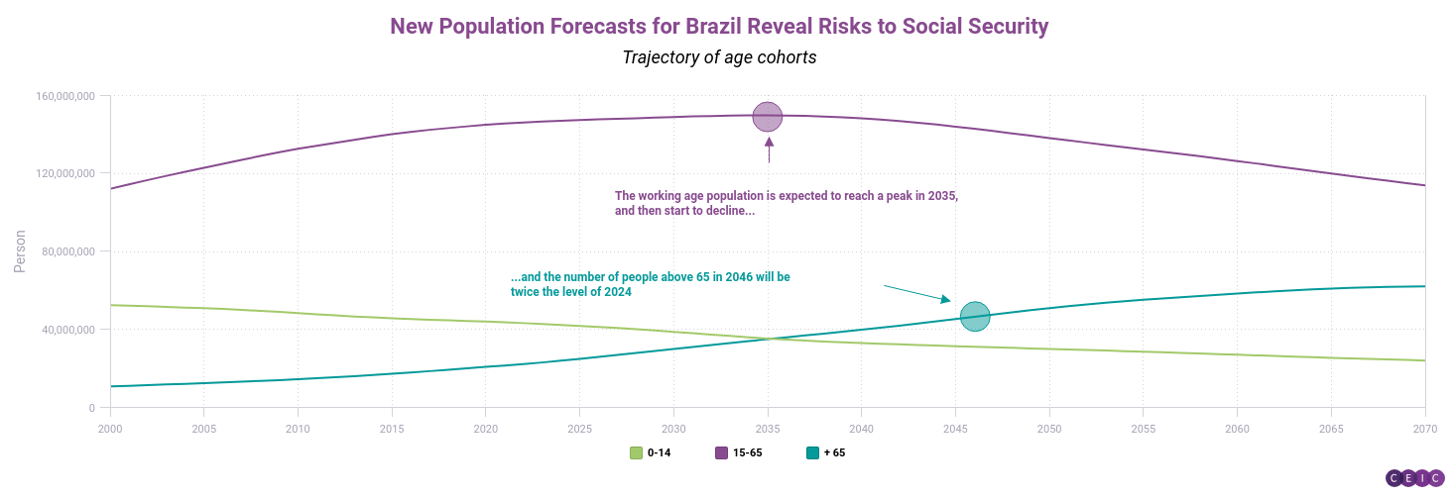
This ratio is expected to decrease to 3.1 by 2046 and then to 1.4 by 2070 -- hence why economists are warning authorities about the urgent need for social-security reforms. (A previous reform, in 2019, sought to improve the country's fiscal situation by introducing a minimum age to collect pensions.)
Another factor undermining the welfare system is an increase in increase in informal workers, who generally do not contribute to social security. According to the IBGE, 38.7% of employed workers in Brazil -- more than 39 million people -- do not have formal labor contracts.
IBGE forecasts also assess regional trends. The northern state of Roraima, which has been receiving a significant influx of immigrants from over its border with Venezuela, and Mato Grosso, a major crop-producing state in the Central West region, are projected to experience the largest population increases by 2070, at 55% and 39% respectively.
By contrast, more populous and developed southern states -- Rio Grande do Sul, Rio de Janeiro, and São Paulo -- may see their populations decline by 19%, 17%, and 14% respectively.
If you are a CEIC user, access the story here.
If you are not a CEIC client, explore how we can assist you in generating alpha by registering for a trial of our product: https://hubs.la/Q02f5lQh0