CEICData.com © 2018 Copyright All Rights Reserved
.png?width=160&name=ceic-logo-Vector%20logo%20no%20tagline%20(002).png)

Is US manufacturing emerging from its malaise? Surprisingly positive data suggests so, but there are caveats.
The Institute for Supply Management's gauge of US manufacturing activity for January showed the fastest growth since 2022. This purchasing managers index (ISM PMI) indicator reached 52.6 points, above the 50 threshold that indicates expansion for the first time in a year.
This came thanks to two components of the PMI — New Orders and Production — both of which saw sharp rebounds in sentiment in January after months of contraction.
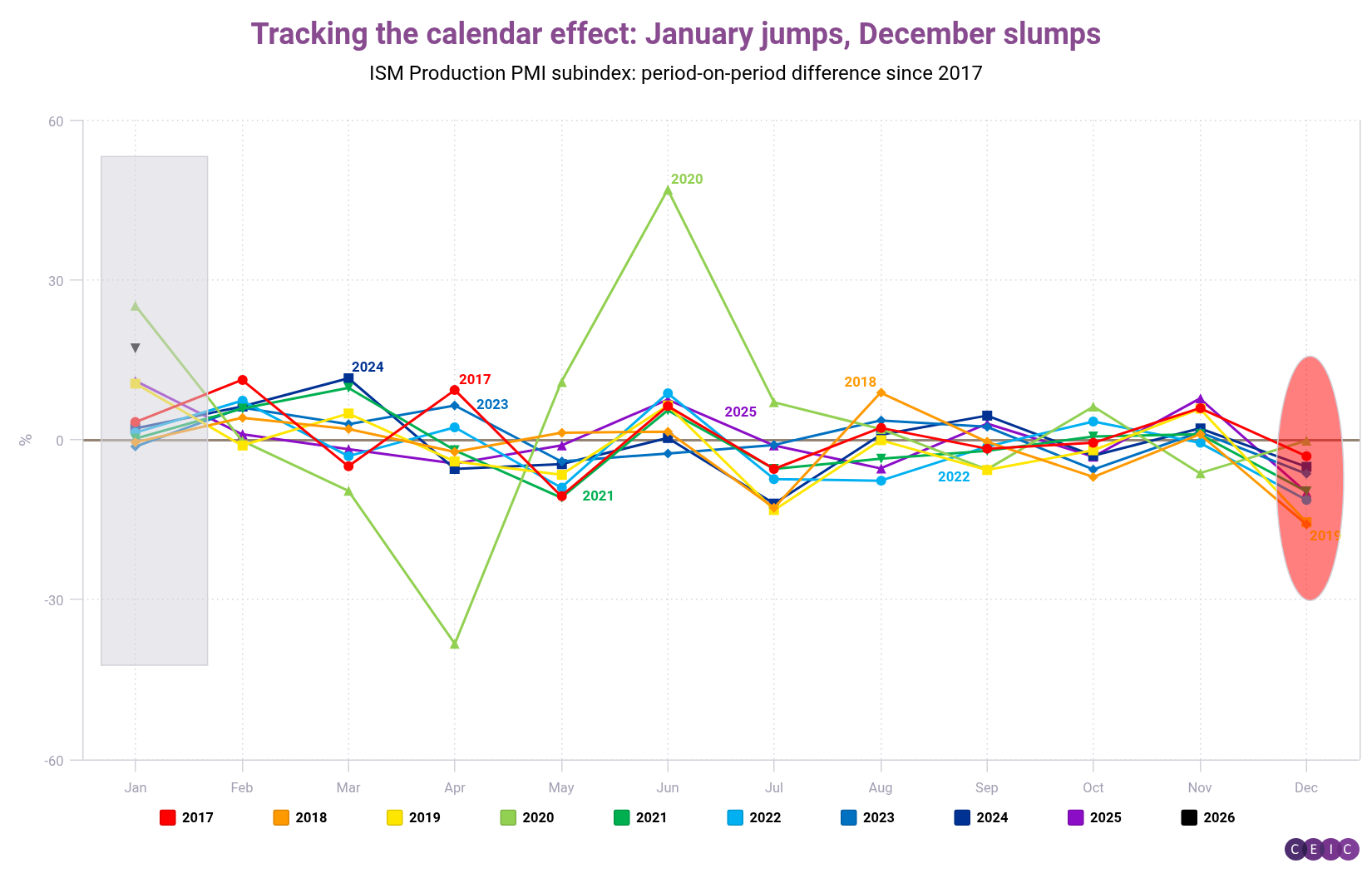
The production subindex swung dramatically into positive territory, rising to +10.2 points from -6.9 in December. However, in context, the sharp turnaround may be amplified by a persistent “calendar effect.” December's net production figures have tended to be biased toward negative territory for the past 10 years; December 2023 and 2024 are cases in point. January's surge could partly reflect a normalization as much as a genuine increase in momentum.
.png?width=1650&height=1050&name=Breaking%20down%20Januarys%20ISM%20PMI%20spike%20new%20orders%20production%20stand%20out%20for%20US%20manufacturing%20gauge%20(1).png)
Our second chart compares PMI production to the Fed's industrial production index (IPI), which it tends to mirror. Unlike the PMI subindex, IPI saw mild month-on-month expansion in December. (The January figure had yet to be released at the time of publication.) We explore the "calendar effect" further in our third chart, which tracks the PMI measure's ten-year trends.

Another positive in the PMI was the New Orders subindex for January, which jumped to its highest reading since mid‑2022. This optimism is supported by the recently reported pickup in realized manufacturing orders through November in the official US Census figures. This may have shaped firms’ outlook for early 2026.
We can also tap alternative, high-frequency datasets that support this narrative. Card transaction data sourced from Facteus indicate strong demand for manufactured goods such as electronics, clothing, and motor vehicles.
The PMI's employment subindex remained stubbornly below the threshold for expansion. On a net basis, this measure has been negative since the second half of 2024, reflecting the weak hiring sentiment despite the surge in new orders and stabilization in production. This also tracks with weak non‑farm payroll growth in the official data -- as well as alternative, high-frequency datasets from Revelio Labs, which demonstrate a slowing trend in new job advertisements since mid‑2022.
Still, BLS data released this week showed that manufacturers' payrolls unexpectedly rose in January, suggesting that the optimism could be trickling down to the labor market. "This is the Trump Economy," a statement from the White House said.
If you are a CEIC user, access the story here.
If you are not a CEIC client, explore how we can assist you in generating alpha by registering for a trial of our product: https://hubs.la/Q02f5lQh0